.webp)
When No-Code Still Makes Sense in 2026
No-code is no longer new, and it is no longer enough to sell a product idea by itself. But that does not mean it stopped being useful. In 2026, no-code still makes sense in specific situations where speed, validation, and operational simplicity matter more than flexibility or long-term product depth. This article explains where no-code still works well, where founders usually push it too far, and how to decide whether it is the right launch path for your startup.

TL;DR: No-code still makes sense in 2026 when the product is narrow, the workflow is simple enough, and the main goal is to validate demand or get a usable first version live quickly.
Why this question still matters
A lot of founders now talk about no-code as if the answer is already obvious. Some treat it like an outdated shortcut. Others still treat it like the default way to launch anything early.
Both views miss the real point.
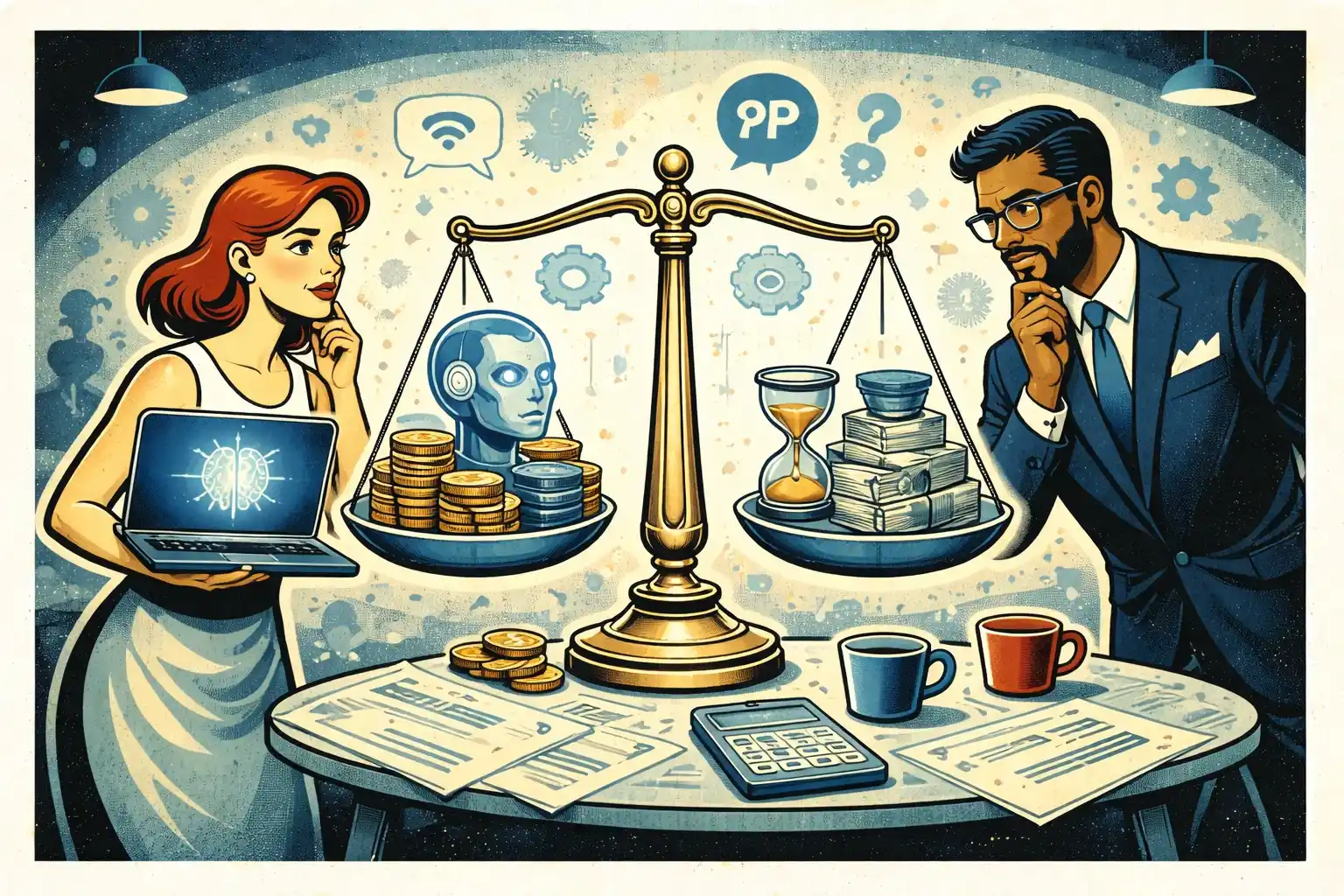
No-code is neither dead nor universally right. It is just more situational now. The useful question is not whether no-code is good or bad. It is whether it fits the actual job your first version needs to do.
That matters even more after the shift in the market. The no-code angle by itself is no longer a strong positioning hook, and teams now have more ways to move fast with custom builds too. The choice has to be based on outcome, not on identity or trend.
Where no-code still works well
No-code still works best when a founder needs a usable product quickly and the workflow does not require too much custom behavior.
That often includes internal tools, client portals, simple marketplaces, admin systems, lightweight dashboards, booking flows, directories, and early service-based products where the first version is meant to prove demand rather than carry the full long-term product vision.
It is also useful when the founder needs something visible fast. A working version that real users can click through often creates far more learning than another month of planning.
This is especially true for non-technical founders who are still validating messaging, flows, or user interest and do not yet need deep custom architecture.
If you are still working out what version one should actually contain, What a Good MVP Looks Like in 2026 is the better place to begin.
When no-code is the right founder move
No-code is usually the right choice when the main risk is not engineering depth, but market uncertainty.
If the founder still needs to answer questions like “Will anyone use this?”, “Can people understand the flow?”, or “Is this enough value to get first traction?”, then speed often matters more than elegance.
It also makes sense when the product can tolerate some platform limits for a while. If version one is expected to be a test environment, a founder may gain more by launching earlier than by investing in a heavier custom build too soon.
There is also a cost advantage in certain early cases. Not because no-code is always cheap, but because it can reduce initial build effort when the scope is disciplined.
That logic overlaps well with Pre-Seed MVP Development for Unfunded Startups on a Budget and Validate a Startup Idea Before Development: 5 Experiments That Work.
Where founders push no-code too far
The problems start when founders try to stretch no-code beyond the job it was chosen for.
One common mistake is taking a tool that worked for validation and expecting it to support a more serious product stage without friction. Another is building increasingly custom logic into a setup that was only efficient while the workflow stayed simple.
The third mistake is emotional attachment. A founder gets attached to the first build path because it helped them start fast, and then avoids admitting that the product is already asking for something else.
At that point, no-code is no longer saving time. It is delaying a clearer technical decision.
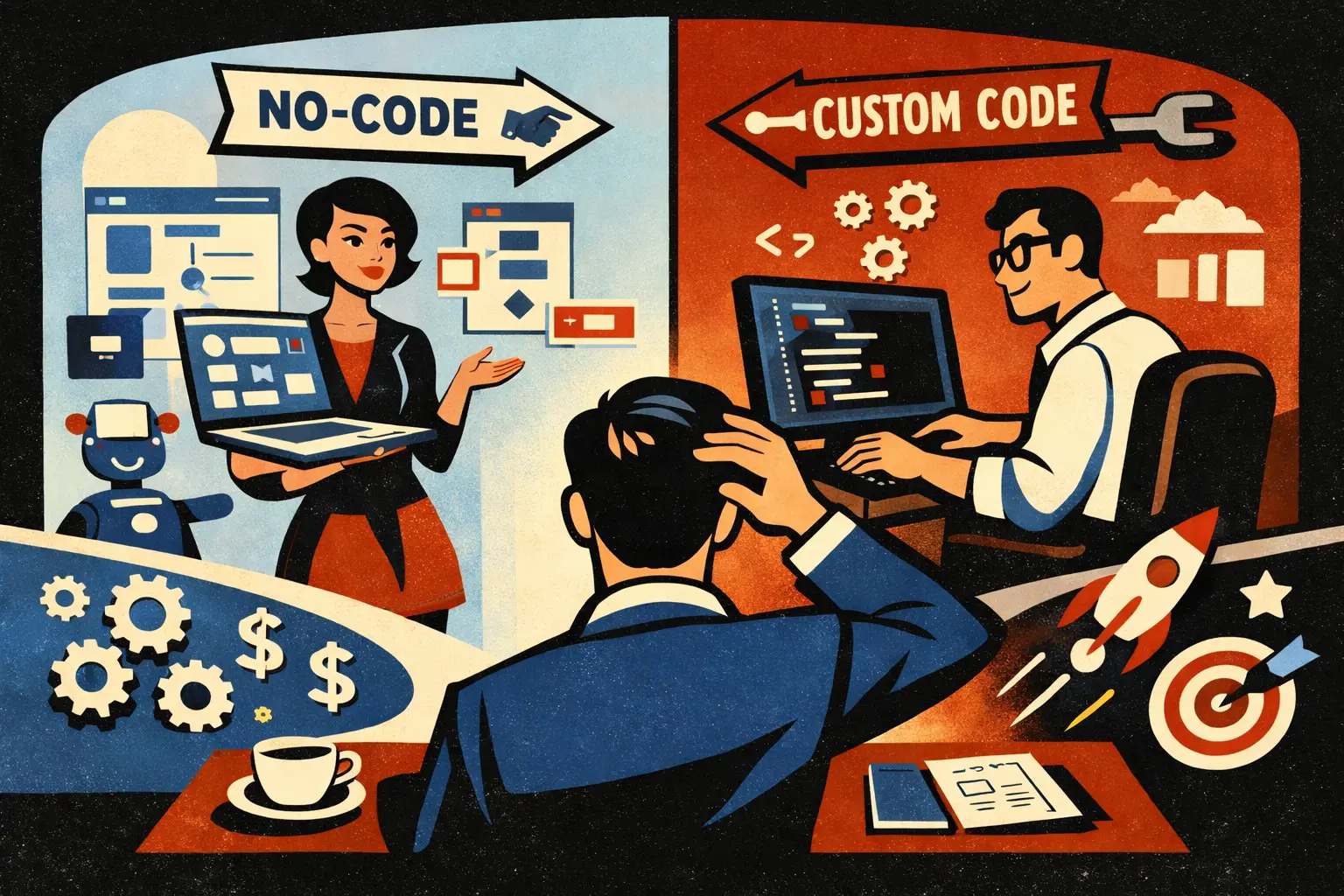
This is closely connected to No-Code vs Custom Development in 2026: A Founder’s Decision Framework.
The signs that no-code still makes sense
There are a few signs that no-code is still the right tool for the moment.
The workflow is understandable and not too unusual.
The product does not depend on advanced integrations or complex backend behavior.
The user experience does not need to feel highly custom from day one.
The founder mainly needs validation, first traction, or a real product to show users and investors.
The team expects that version one may change a lot once real feedback comes in.
If those conditions are true, no-code can still be a practical move in 2026.
The signs that it probably does not
No-code usually stops making sense when the product starts needing more than the platform can comfortably support.
That often happens when there are unusual permissions, more layered user roles, deeper integrations, performance demands, more customized UX, or product logic that is clearly no longer “standard flow + simple rules.”
It also becomes the wrong path when the founder already knows version one is not just for validation. If the goal is to build a stronger foundation for growth, retention, more serious monetization, or investor-facing confidence, a custom path may be safer earlier than the founder expects.
Why the answer changed in 2026
In earlier years, no-code often won the speed conversation by default. That is less true now.
AI-assisted development, stronger frameworks, and more focused MVP processes have made custom development faster than many founders assume. So the founder no longer needs to choose no-code simply because it feels like the only fast option.
That changes the decision. No-code now needs a clearer reason to be the right tool. It still has one in many cases, but the founder should choose it because it fits the product stage, not because it sounds automatically lean.
A practical founder framework
Start with one question: what do you need to prove first?
If you need to prove interest, flow, or basic usability, no-code may still be enough.
Then ask whether the product logic is likely to stay simple for long enough to justify the choice.
Then ask whether you are comfortable treating the first version as temporary if needed.
Then ask whether the current platform limits are acceptable for the actual business goal, not just acceptable in theory.
This is also where How Long MVP Development Takes in 2026 and Reducing MVP Rework in 2026: Key Decisions become useful.
What founders should do emotionally, not just technically
A lot of bad no-code decisions are not technical. They are emotional.
Founders sometimes avoid the next technical step because they are afraid of more cost, more uncertainty, or losing the comfort of a faster first build. That is understandable, but it can create bigger waste later.
The healthier approach is simple: use no-code confidently when it fits the job, and move on from it confidently when it no longer does.
There is no shame in either choice. The real mistake is pretending the tool is still serving the product when it is only serving your attachment to the first version.
That is part of Startup Building Without a Tech Team in 2026 and Choosing a Development Agency in 2026 too.
Final thought
No-code still makes sense in 2026, but only when the founder is honest about what the product needs right now.
It is still a strong option for validation, speed, and getting a real product in front of users without overcommitting too early. But it is no longer something founders should choose automatically.
The smartest approach is simple: use no-code where it helps you learn faster, and stop using it the moment it starts hiding the real shape of the product you are actually building.
Thinking about building a startup MVP in 2026?
At Valtorian, we help founders design and launch modern web and mobile apps — including AI-powered workflows — with a focus on real user behavior, not demo-only prototypes.
Book a call with Diana
Let’s talk about your idea, scope, and fastest path to a usable MVP.
FAQ
Is no-code still relevant for startups in 2026?
Yes, but mainly in focused situations where speed and validation matter more than long-term flexibility.
What kinds of products still fit no-code well?
Internal tools, simple marketplaces, portals, dashboards, booking flows, and early validation products often still fit well.
Is no-code cheaper than custom development?
Sometimes at the start, yes. But if the product outgrows the setup quickly, the total cost can rise because of rebuilds and workarounds.
When should a founder move away from no-code?
When the product starts needing more custom logic, deeper integrations, stronger performance, or a more tailored user experience.
Can no-code still be used for MVPs?
Yes. In many cases it is still a practical MVP path, especially when the first goal is learning, not long-term technical depth.
Is no-code a bad signal to investors?
Not by itself. Investors usually care more about what you proved, how fast you moved, and whether the product showed real traction.
What is the safest way to think about it?
As a stage-based tool. Use it while it clearly supports the business goal, and do not force it to become the final foundation if the product has already evolved past that point.




































.webp)




.webp)