.webp)
APIs vs Webhooks for Startup MVPs in 2026: What Founders Need to Know
Founders hear “API” and “webhook” all the time, but in early MVP planning, the real question is simpler: how should your product send or receive information without creating unnecessary complexity? This article explains the difference in plain English, shows when each approach makes sense, and helps non-technical founders avoid integration decisions that slow down launch. If you are building a startup MVP in 2026, this is one of those small technical choices that can quietly affect cost, speed, and product scope.
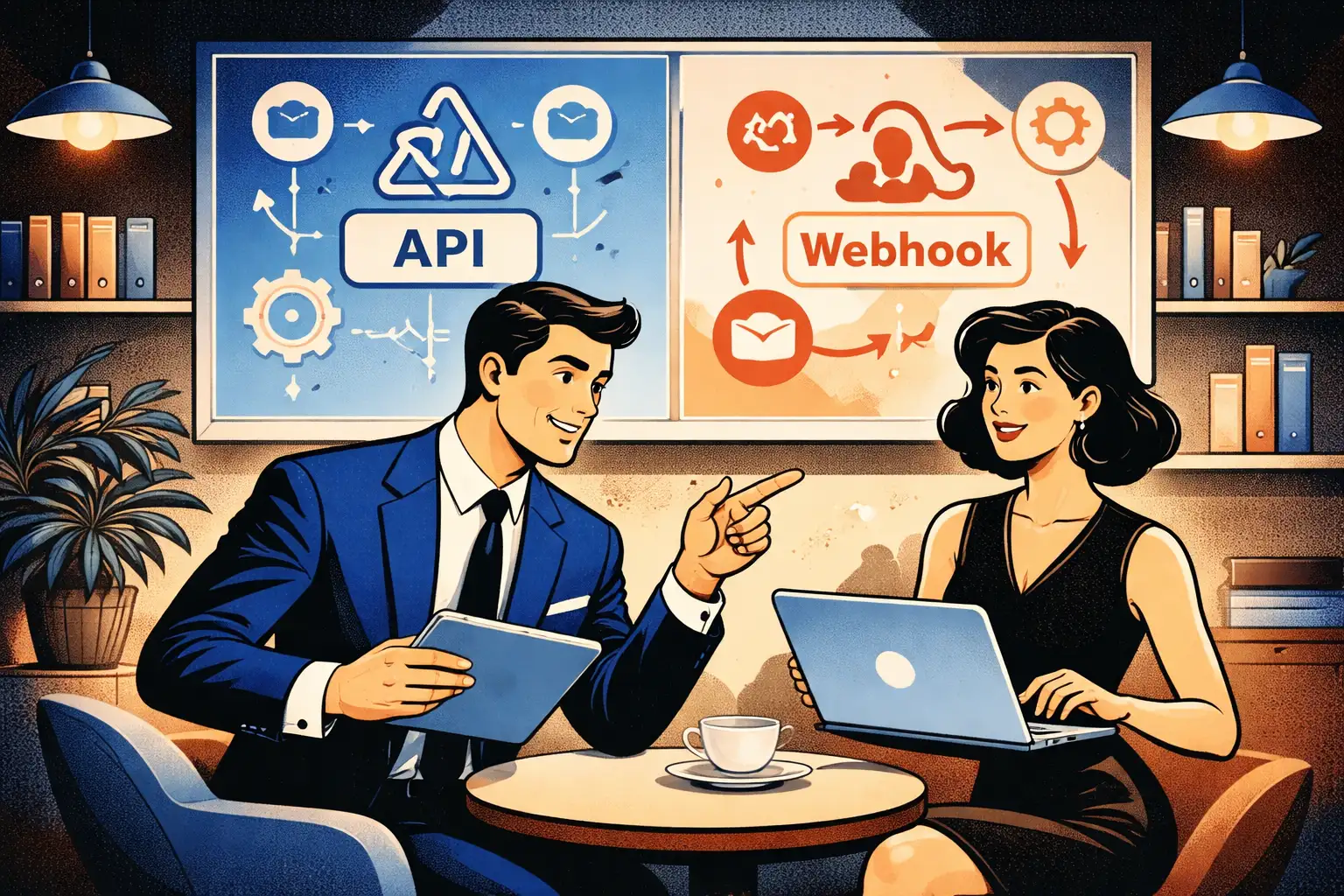
TL;DR: APIs and webhooks both help your MVP connect with other systems, but they solve different problems. APIs are better when your app needs to ask for data on demand, while webhooks are better when your app needs to react automatically when something changes.
Why founders keep hearing both terms
When you build an MVP, you quickly run into moments where your product needs information from somewhere else. Maybe you want to pull payment status from Stripe, sync leads into a CRM, notify users when a booking changes, or create a task when someone submits a form. That is where APIs and webhooks usually enter the conversation.
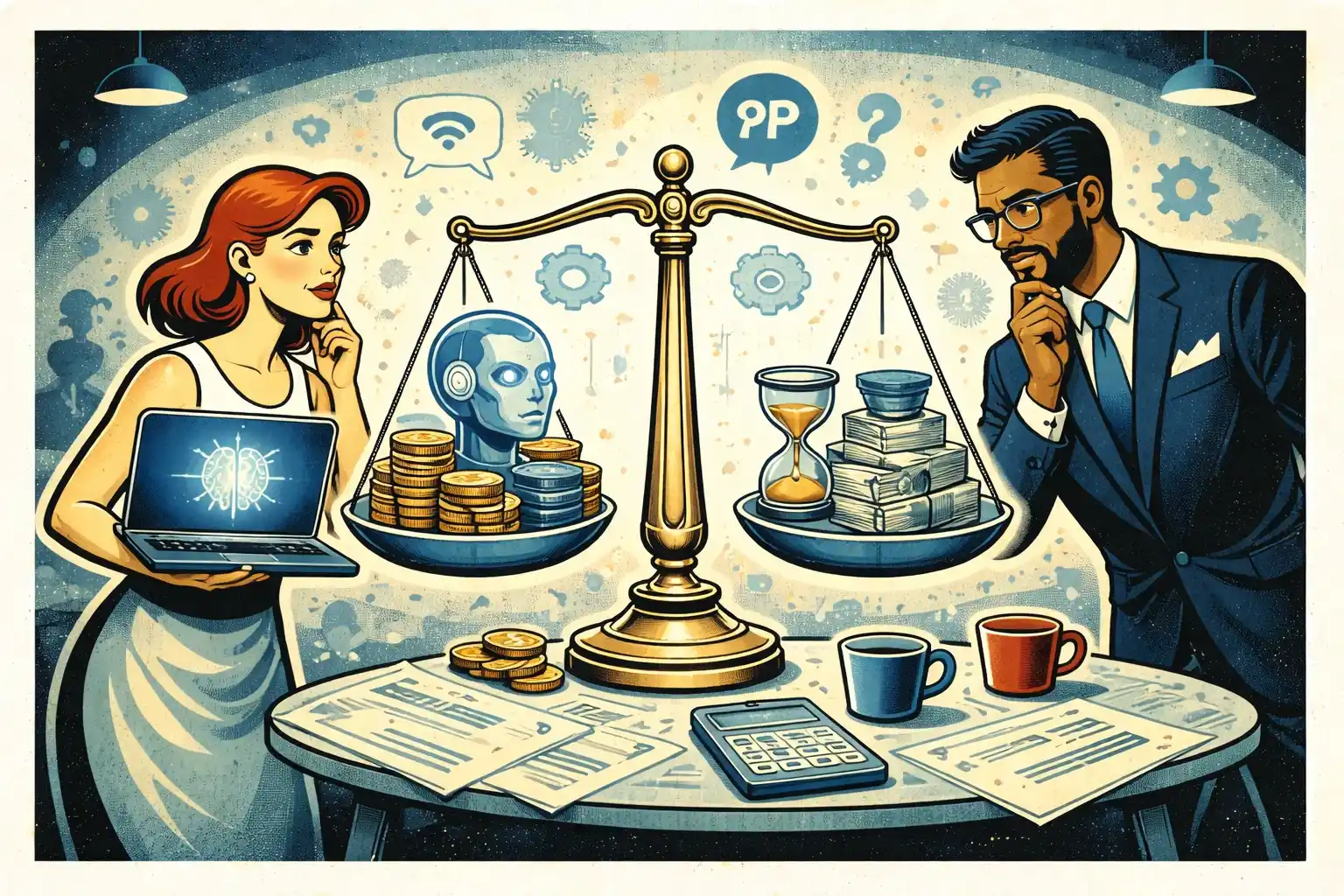
The problem is that many founders hear these terms too early and too vaguely. They start sounding like architecture decisions when they are often just workflow decisions. In practice, the real question is: does your product need to request data when it wants it, or should another system notify your product when something happens?
If you are still shaping the first version of your product, What a Good MVP Looks Like in 2026 helps frame why these choices should follow product scope, not technical excitement.
What an API is, in simple founder language
An API is a way for one system to ask another system for something. Think of it like a request. Your app asks for data, sends an action, or checks a status, and the other system responds.
For example, your app might ask a payment provider whether a transaction was successful. Or it might request customer details from a CRM. Or it might send a prompt to an AI service and get a generated response back.
The important part is this: the request starts from your side. Your app decides when to ask. That makes APIs useful when the product needs control over timing or when users expect fresh information at the moment they open a screen or click a button.
This also connects to Tech Decisions for Founders in 2026, because many early technical mistakes happen when founders approve infrastructure they do not yet need.
What a webhook is, in simple founder language
A webhook works differently. Instead of your app asking again and again whether something changed, another system sends a message to your app automatically when the change happens.
A common example is a payment event. Instead of your product checking every few minutes whether a payment was completed, the payment provider sends a webhook the moment that payment succeeds, fails, or is refunded. Your app then reacts to that event.
That makes webhooks useful when your product should respond to real-time events without constant checking. They are often cleaner for background automation, status updates, and sync flows between tools.
If your MVP includes outside services, Payments for MVPs in 2026: Stripe Decisions That Matter is a natural related read.
The real difference: pull vs push
The easiest way to understand the difference is this:
An API usually means your product pulls information when it needs it.
A webhook usually means another system pushes information to your product when something happens.
That distinction matters because it affects cost, speed, reliability, and product behavior. Pulling data too often can create waste, clutter, and engineering overhead. Pushing data into the wrong place can create confusion if your team has not clearly defined what should happen after each event.
For an early-stage founder, this is not just technical vocabulary. It affects how quickly your product can be built and how easy it will be to maintain after launch.
When APIs make more sense in an MVP
APIs usually make more sense when a user is actively doing something and expects the latest result immediately. If a founder dashboard loads company data, if a user checks their account balance, or if your product generates a recommendation after a click, an API call is usually the clearer choice.
APIs are also useful when the product needs to request data only occasionally. If you do not need constant event-driven automation, adding webhook logic too early can be unnecessary.
For many startup MVPs, APIs are the better default because they are easier to reason about at the beginning. The team can focus on the main workflow first, then add event-based logic later if real usage justifies it.
That kind of restraint is part of MVP Scope and Focus in 2026.
When webhooks make more sense in an MVP
Webhooks usually make more sense when something important happens outside your app and your product should react without waiting for a manual refresh or repeated polling.
Examples are everywhere: a payment goes through, a document gets signed, a lead enters your CRM, a subscription renews, an email is delivered, or a booking is canceled. In those cases, waiting for a user action or repeatedly checking status can be clumsy and expensive.
Webhooks are especially useful when your MVP depends on background automation. But they only help if you clearly know what each incoming event should trigger. If that logic is still fuzzy, webhook-heavy architecture can create more confusion than value.
If you are trying to reduce unnecessary complexity before launch, Feature Freeze in 2026: Stopping Scope Creep fits well here.
Most MVPs need both — but not everywhere
This is where founders often get misled. The answer is usually not “APIs are better” or “webhooks are better.” Most real MVPs use both, but in different places.
A product might use APIs for user-facing actions and webhooks for background updates. For example, a SaaS tool might use an API to create a customer and fetch their plan details, then use webhooks to react when billing status changes. An AI workflow might use an API to generate output on demand, but use webhooks to handle a completed background process from another service.
The key is to avoid turning a simple MVP into an integration playground. Version one should only use the patterns that support the main user journey.
That is also why Launching an MVP the Right Way in 2026 matters more than adding “advanced integrations” too early.
Founder mistakes to avoid
The first mistake is building integrations before the workflow is stable. If you do not yet know what your product should do when an event arrives, it is too early to add event-driven complexity.
The second mistake is using APIs to repeatedly check for changes that should really arrive as events. That can create waste, hidden cost, and brittle logic.
The third mistake is using webhooks everywhere because they sound more advanced. For many early products, a simple API request on demand is easier, cheaper, and more than enough.
The fourth mistake is not planning fallback behavior. What happens if a webhook fails? What happens if the API is temporarily unavailable? Founders do not need to design full enterprise resilience in version one, but they do need basic clarity.
These mistakes overlap with MVP Development for Non-Technical Founders: 7 Costly Mistakes.
A practical founder framework
If you are unsure what to choose, use this simple logic.
If the user is waiting on the screen for a result, start by thinking API.
If another tool should notify your product when something changes, start by thinking webhook.
If the workflow is still not proven, choose the simpler implementation first.
If the integration is not central to version one, do not build it yet.
This is also where Estimating MVP Scope in 2026: A Simple Method becomes useful, because integration choices often look small but quietly expand the build.
Examples founders can understand quickly
If your app lets users pay and then unlocks access, you might use an API to create the checkout session and a webhook to confirm the payment result.
If your app shows live shipping data, you might use an API to request tracking information when the user opens the order page.
If your app sends data from one internal tool to another after a form submission, a webhook may be the cleaner option.
If your app depends on AI output after a user clicks “generate,” that is usually an API-style request. But if another service finishes a long-running task later and needs to report back, that starts looking more like a webhook use case.
This is why AI + Human Workflows in 2026: The Best Hybrid Pattern can also be relevant when your product mixes manual and automated steps.
Final thought
For startup MVPs in 2026, the smartest integration decision is usually the least dramatic one. APIs and webhooks are both useful, but neither should drive the product. The workflow should.
If your team understands what the user is trying to achieve, when the system needs fresh data, and when an outside event should trigger a response, the choice becomes much easier. Founders do not need to master integration engineering. They just need enough clarity to avoid paying for complexity that version one does not need.
Thinking about building a startup MVP in 2026?
At Valtorian, we help founders design and launch modern web and mobile apps — including AI-powered workflows — with a focus on real user behavior, not demo-only prototypes.
Book a call with Diana
Let’s talk about your idea, scope, and fastest path to a usable MVP.
FAQ
Are APIs and webhooks competitors?
No. They solve different problems and often work together in the same product.
Is a webhook faster than an API?
Not exactly. A webhook is better for event-based updates because the information is sent when something happens. An API is better when your app wants to request data on demand.
Does every MVP need webhooks?
No. Many MVPs can start with simple API-based flows and add webhooks later only when real-time updates become important.
Are webhooks more complicated to maintain?
They can be, especially if your product reacts to many event types or if failure handling is unclear.
What is better for payments in an MVP?
Usually both. APIs are often used to create payment flows, while webhooks are used to confirm what happened after the payment event.
Can a non-technical founder make this decision well?
Yes, if the team explains the workflow clearly. The founder does not need deep technical knowledge — only a clear view of what the product should do and when.














































.webp)




.webp)