.webp)
What Founders Regret Building Too Early in 2026
Founders rarely regret building too little at the start. Much more often, they regret building things too early. The pattern is familiar: advanced features, complex dashboards, automation, admin logic, and polished systems that looked important before launch but did not matter enough once real users arrived. In 2026, the smartest early-stage teams still win through focus, not early completeness. This article breaks down what founders most often regret building too early, why it keeps happening, and how to avoid spending precious time and budget on things the market has not yet earned.
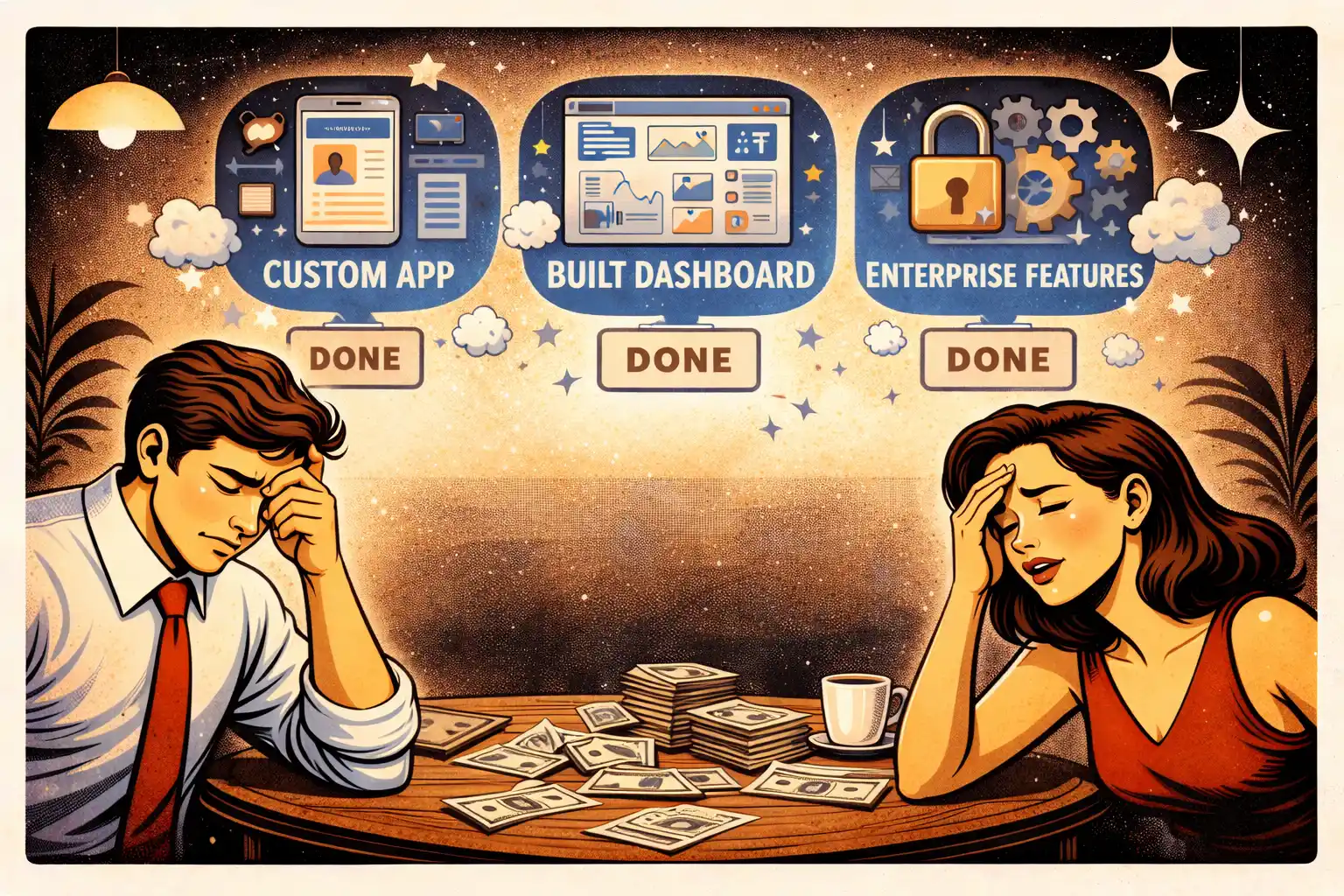
TL;DR: Founders usually regret building features, systems, and infrastructure too early when those things support a future version of the business, not the current proof goal. The biggest regrets tend to come from admin tools, advanced dashboards, edge-case logic, automation, multi-role complexity, and “nice to have” polish that did not help validate core value.
Why founders build the wrong things too early
This usually does not happen because founders are careless. It happens because the future feels persuasive.
A founder can clearly imagine the product at scale. They can see internal teams needing dashboards, users expecting advanced settings, enterprise buyers asking for controls, and the product becoming more complex over time. That future picture feels so logical that parts of it start entering version one long before the startup has earned them.
There is also an emotional reason. Building advanced things feels like progress. It makes the product feel more serious, more complete, and more defensible. But early-stage products are not judged by how much future they contain. They are judged by whether they solve a current problem clearly enough to create traction.
The first regret: advanced admin panels
Admin panels are one of the most common early regrets.
Founders imagine all the internal control they will eventually need, so they start building management layers, moderation tools, back-office workflows, approval systems, and reporting views before the product even has enough live activity to justify them.
Some admin tooling is necessary, of course. But most early products do not need a powerful internal control center. They need a simple way to support the core workflow and keep the team moving.
A large admin surface often gets built for comfort, not for validation.
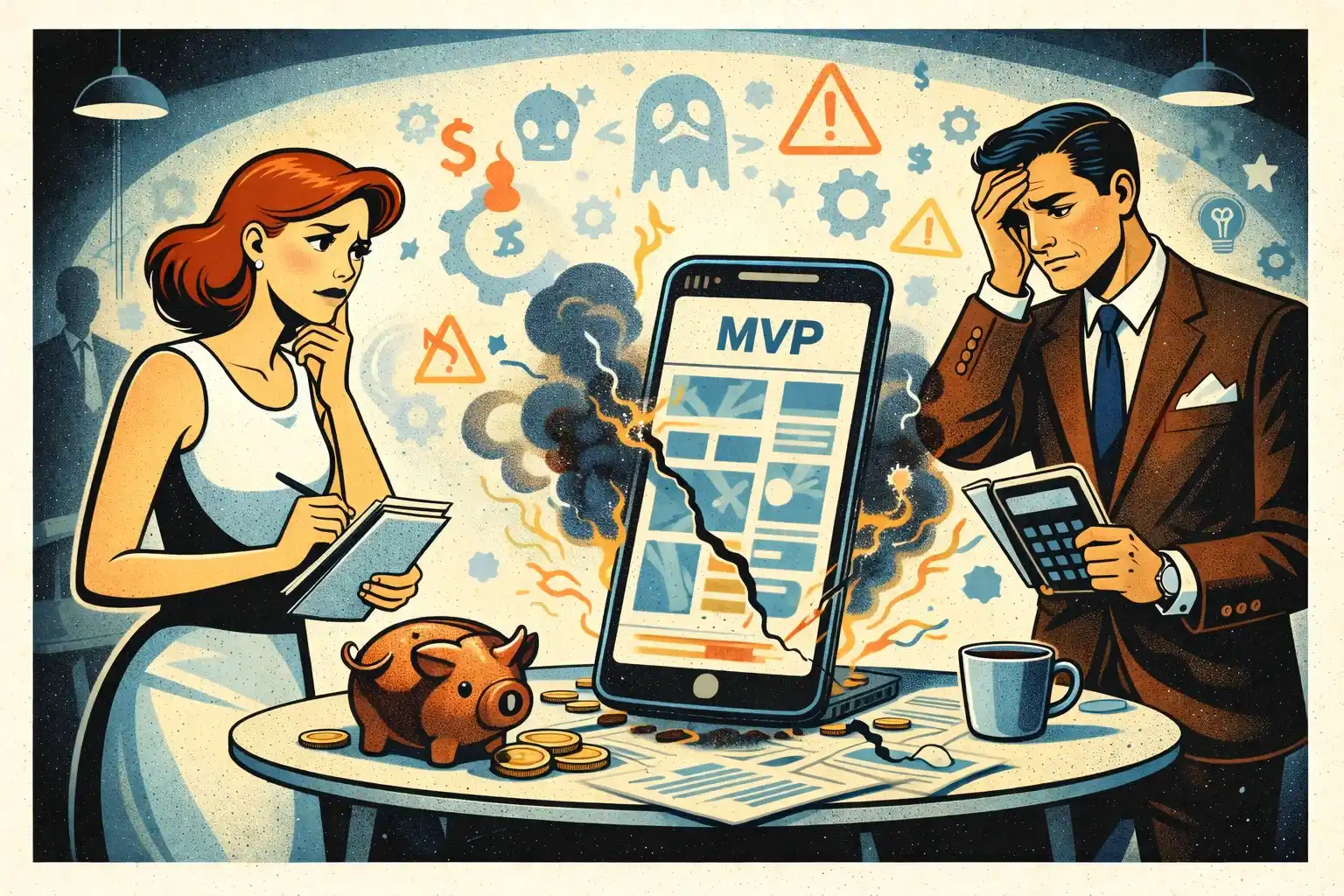
That connects naturally to How to Know Your MVP Is Too Big in 2026.
The second regret: dashboards before decisions exist
Founders also regret building elaborate dashboards too early.
The idea sounds reasonable: if we launch, we need visibility. So teams build analytics screens, reporting layers, segmentation tools, visual summaries, and internal charts before they have enough users or clear enough decisions to justify all that structure.
The problem is not dashboards themselves. The problem is building them before the startup knows what decisions they need to support.
In the early stage, a few essential metrics are usually enough. A full analytics experience often belongs later.
This is why Your First Product Metrics Dashboard: What Early-Stage Investors Want to See and MVP Analytics in 2026: Events to Track Early are more useful than building a bigger dashboard by default.
The third regret: multi-role complexity
Another expensive early regret is building too many user roles too soon.
A founder imagines the full ecosystem: end users, admins, partners, operators, reviewers, managers, maybe vendors, maybe clients, maybe internal staff. Each role then starts needing its own flows, permissions, dashboards, notifications, and edge cases.
This is how a simple idea turns into a layered system before the startup has even proven the first value path.
Multiple roles are sometimes necessary. But when they arrive too early, they usually multiply build time faster than they multiply learning.
That is why early products tend to work better when they start with the minimum number of roles required to test the main outcome.
This fits well with MVP Scope and Focus in 2026.
The fourth regret: automation before pattern
Automation is another common early regret.
Founders often want workflows to feel efficient from day one. So they automate onboarding, internal ops, user routing, notifications, reminders, or back-office logic before they fully understand what the best version of that process even looks like.
That creates a hidden problem: automation freezes assumptions. If the workflow is still evolving, automation can make the wrong process feel more permanent.
This is why many early-stage teams later realize they would have learned faster by handling more of the process manually for longer.
That is exactly where What Founders Should Automate First in 2026 and Manual-First MVPs in 2026: What to Do Before Automating become useful companion reads.
The fifth regret: enterprise-style features
Founders also regret building enterprise-style features too early.
Permissions layers, detailed roles, audit logs, complex exports, deep settings, heavy compliance-facing flows, custom account structures, and other enterprise-oriented mechanics often enter the roadmap because they sound strategic.
Sometimes they are strategic. But very often they belong to a later sales motion, not to the first product proof.
When these features appear too early, they usually make the MVP harder to launch and harder to learn from without creating equivalent early value.
A common startup mistake is solving for the customer they hope to sell later instead of the first user they need now.
That also relates to The First 5 Product Decisions in 2026 because once the first audience and proof goal are clear, many “enterprise” ideas naturally move out of version one.
The sixth regret: polished UX around unproven value
Founders sometimes regret not just what they built, but how much polish they poured into it too early.
A beautiful interface is not a bad thing. The problem comes when polish is being used to compensate for weak product certainty.
Too many onboarding screens, too many states, too much refinement around flows that are not yet proven, or too much design energy spent on comfort rather than clarity can slow the team down without improving learning.
The right early product usually needs enough quality to feel trustworthy and usable. It does not need full maturity before the startup knows whether the core value actually lands.
Why these regrets keep repeating
These regrets repeat because the wrong things are often easier to justify than the right things.
A feature can be defended as useful.
A dashboard can be defended as strategic.
An admin panel can be defended as necessary for scale.
Automation can be defended as efficient.
Enterprise controls can be defended as future-ready.
Each item sounds rational on its own. The real damage appears when all of them enter the MVP before the startup has real users, clear metrics, and proof that the core value is working.
That is why the safer question is not “Could this help later?” It is “Do we need this now to learn what matters?”
A practical founder filter
Before adding anything to version one, ask four questions.
Does this help prove the core value?
Would removing it make the MVP unable to teach us something important?
Can this be handled manually for now?
Is this solving a current problem or a future fantasy?
If the answer to the last question is “future,” that item is often a candidate to move later.
That is why What to Build First in 2026: Website, MVP, or Manual Service and Reducing MVP Rework in 2026: Key Decisions fit so well here.
Final thought
What founders regret building too early in 2026 is usually not random. It is the same family of mistakes: building for future complexity before present proof.
The features may differ from startup to startup, but the pattern stays the same. Teams build internal control too early, polish too early, automate too early, and scale for users they do not yet have.
The strongest early products are rarely the ones with the most built in. They are the ones that stay focused long enough to learn what the market actually rewards.
Thinking your roadmap may already include things that belong later?
At Valtorian, we help founders cut through early-stage noise, define the smallest useful version, and launch products that create real traction instead of expensive regret.
Let’s look at your current scope, what your product actually needs now, and what should wait until the market earns it.
FAQ
What do founders most often regret building too early?
Usually admin panels, advanced dashboards, multi-role complexity, automation, enterprise features, and polish around unproven flows.
Why do founders build these things too early?
Because they are planning for a future version of the company before the startup has proven its present value clearly enough.
Are dashboards always a bad early decision?
No. A few essential metrics are useful early. The regret usually comes from building a full reporting experience before it is needed.
Should startups automate operations early?
Only the parts that are repetitive, clear, and low-risk. Learning-heavy workflows usually need to stay more manual for longer.
Are enterprise features ever worth including in an MVP?
Sometimes, but only if they are required to validate the first real audience and core value path.
How can I tell if something belongs later?
Ask whether it helps prove the core value now, whether it could be handled manually, and whether it solves a current problem or a future assumption.
What is the safest early product rule?
Build only what helps the startup learn something meaningful from real users as quickly as possible.
























































.webp)




.webp)