.webp)
Supabase MVP Architecture in 2026: Practical Patterns
Supabase is a popular choice for startup MVPs because it gives you a production-grade Postgres core with authentication, storage, and real-time features—without building a full backend from scratch. But “easy to start” can become “hard to maintain” if the architecture is messy. This guide explains practical Supabase MVP patterns in 2026 for non-technical founders: how teams structure data, permissions, APIs, background jobs, and file storage so the MVP stays fast to ship and safe to scale.
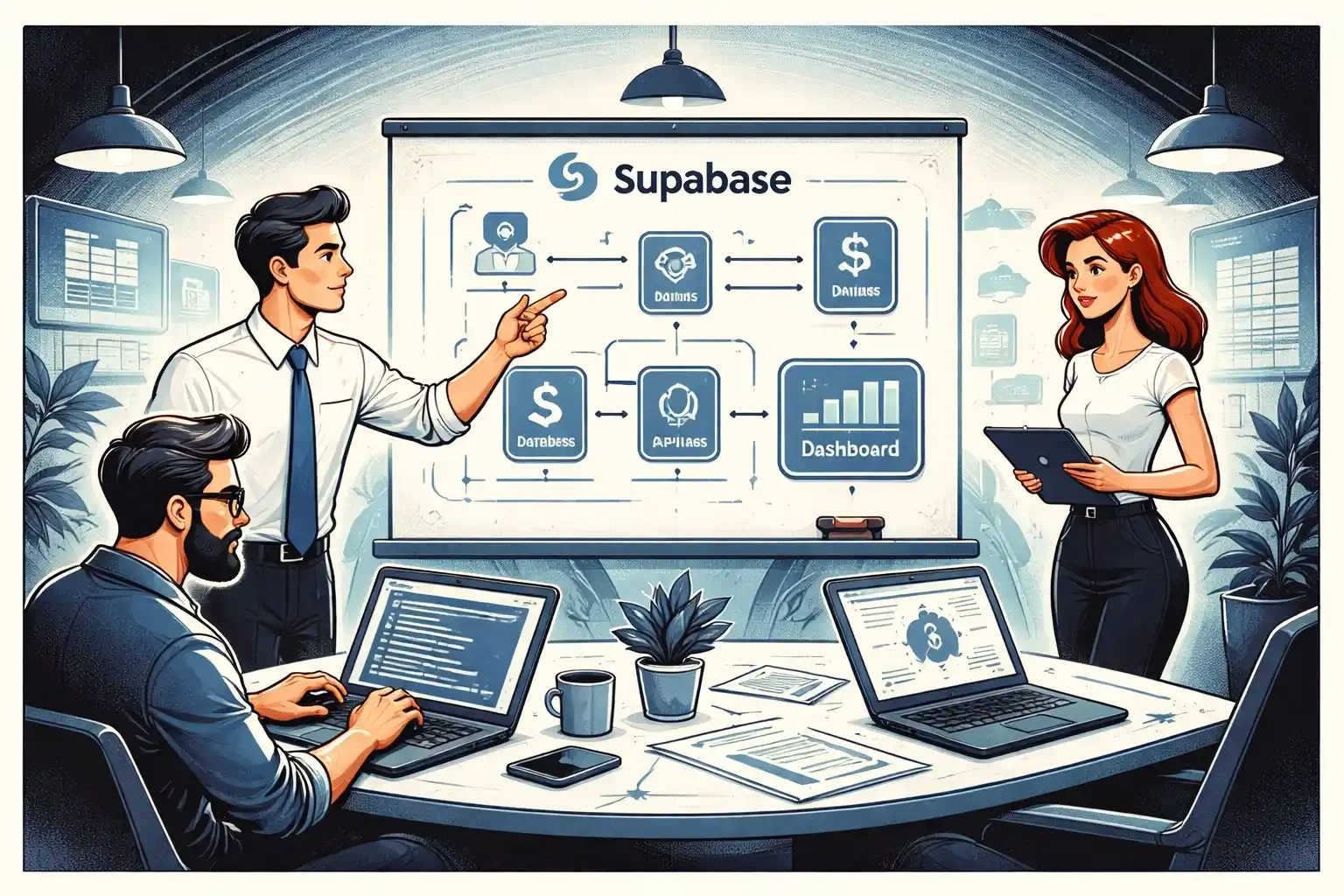
TL;DR: The safest Supabase MVP architecture in 2026 is “Postgres-first, RLS-first, thin backend.” Put core business logic close to the database, use Row Level Security for permissions, keep Edge Functions for trusted server-side actions, and avoid rebuilding an API layer you don’t need. Design your data model and auth flows carefully early — most Supabase MVP problems come from permissions and data structure, not from UI.
Why Supabase is still a strong MVP choice in 2026
Supabase is attractive for MVPs because it compresses the backend surface area:
- Postgres as the source of truth
- Auth built-in
- Storage for files
- Realtime for updates
- Edge Functions for server-side logic
For non-technical founders, the key is not “is Supabase good?” but “can my team keep it clean?”
If you’re still deciding between backends, start with Supabase vs Firebase for Your Startup MVP Backend.
The MVP architecture principle: thin backend, strong database
For early-stage products, the best pattern is:
- Database rules and constraints do the heavy lifting
- Frontend calls the database directly where it’s safe
- Server-side functions exist only where trust is required
This keeps your MVP simpler and cheaper to iterate.
A common mistake is building a traditional backend API out of habit. If your use case is mostly CRUD + permissions, Supabase already gives you most of what you need.
Pattern 1: Data model first (because everything depends on it)
In Supabase, your database is the core of the product.
A practical MVP approach:
- Define 5–12 core entities (tables) only
- Use UUID primary keys
- Use timestamps consistently
- Prefer explicit join tables for many-to-many relationships
What founders should watch:
- If the team can’t explain the data model in plain English, it’s not ready
- If every feature requires a new table, the model is probably wrong
If you want a founder-friendly view of architecture decisions, see Web App Development for Startups: Architecture Basics for Non-Tech Founders.
Pattern 2: RLS-first permissions (do this early or pay later)
Row Level Security (RLS) is Supabase’s superpower — and also the main source of pain when done late.
RLS-first means:
- Every table that stores user-related data has RLS enabled
- Policies are written as part of the feature (not after)
- You test access rules with multiple user roles from day one
A simple rule of thumb:
- If a user should never see another user’s record, enforce it in RLS
- If access is role-based (admin, staff, customer), enforce it in RLS
This is how you avoid “accidentally public” data.
Pattern 3: Auth flows that match the product (not just “email login”)
Most MVP bugs are not “auth is broken,” but “auth doesn’t match the business.”
Decisions you must make early:
- Do users belong to an organization/workspace?
- Can users switch workspaces?
- Are there invited users (team members) and who can invite them?
- Do you need email verification or magic links?
Typical MVP approach:
- Single user = simplest
- User + org/workspace = common for B2B
- User + multi-tenant org + roles = more complex but often necessary
If you skip this, you’ll rebuild permissions later.
Pattern 4: Database triggers for integrity (lightweight, not fancy)
Triggers are useful when you need consistent data changes that should happen automatically.
Examples where triggers make sense:
- When a user signs up, create a profile row
- When an order is created, generate a reference number
- When a payment status changes, update a derived “state” field
Where triggers can hurt:
- If business logic becomes hard to understand or debug
Keep triggers small and predictable.
Pattern 5: Edge Functions for trusted actions (payments, secrets, webhooks)
Use Edge Functions when you must:
- Handle third-party webhooks (payments, email providers)
- Use secret keys securely
- Perform actions that should never run on the client
- Validate input before writing sensitive data
Good MVP discipline:
- Keep functions small
- Make them idempotent (safe to retry)
- Log the important events
If your MVP includes payments, Edge Functions are usually required for webhook processing and secure operations.
Pattern 6: Storage design (files, documents, and “don’t leak URLs”)
Supabase Storage is great for MVPs, but you need structure.
Practical setup:
- Separate buckets by purpose (avatars, public assets, private documents)
- Use private buckets for anything sensitive
- Prefer signed URLs for private files
- Store only file metadata in tables (path, owner_id, type, created_at)
Founder warning:
- If files are sensitive (IDs, passports, contracts), you must treat access controls seriously and avoid public buckets.
Pattern 7: Realtime only for what truly needs it
Realtime is tempting, but don’t make it your default.
Use realtime for:
- Chat messages
- Live status updates (job progress, delivery status)
- Collaborative dashboards (when it matters)
Avoid realtime for:
- Everything in the app “just because”
For most MVPs, polling + good UX is enough.
Pattern 8: Background jobs and queues (the “MVP-safe” way)
Supabase doesn’t force you into a heavy queue architecture. For MVPs, you have options.
A practical MVP pattern:
- Create a “jobs” table
- Insert a row for work to be done
- Process it via a scheduled function or a lightweight worker
- Store status (queued, processing, done, failed)
This avoids overbuilding early.
Pattern 9: Analytics and audit trails (minimal, but real)
In 2026, launching without visibility is a mistake.
MVP-friendly approach:
- Track a small set of product events (activation, core action, retention proxy)
- Add audit logs for sensitive actions (role changes, payouts, deletes)
If you need a quick framework for what to measure, see Your First Product Metrics Dashboard: What Early-Stage Investors Want to See.
The “don’t overbuild” checklist for Supabase MVPs
If your team proposes these early, ask why:
- A custom backend API layer “because that’s standard”
- Microservices
- Complex event buses
- Premature sharding or multi-region setup
MVP architecture is about removing risk, not collecting tech.
If you want an overall MVP scope discipline framework, this complements it well: MVP Development for Non-Technical Founders: 7 Costly Mistakes.
When Supabase is NOT the right choice
Supabase may be a poor fit when:
- You need very custom compute-heavy backend processing from day one
- You require strict enterprise compliance constraints without the ability to control hosting details
- Your product is extremely latency-sensitive and global from the start
Most early-stage startups don’t start here — so Supabase remains a strong default.
Thinking about building a web or mobile MVP in 2026?
At Valtorian, we help founders design and launch modern web and mobile apps — including AI-powered workflows — with a focus on real user behavior, not demo-only prototypes.
Book a call with Diana
Let’s talk about your idea, scope, and fastest path to a usable MVP.
FAQ
Do I need a separate backend if I use Supabase?
Often no. Many MVPs can use Supabase directly from the frontend with RLS policies, and add Edge Functions only for trusted server-side actions.
What’s the biggest Supabase mistake teams make?
Delaying RLS and permissions decisions. If access rules are added late, teams end up rewriting queries, policies, and sometimes the data model.
When should I use Edge Functions?
Use them for webhooks, secret key operations, admin-only actions, and any logic that must not run on the client.
How do I store private user documents safely?
Use private buckets, store metadata in tables, and serve files via signed URLs with strict ownership checks in RLS.
Can Supabase scale beyond MVP?
Yes for many products, especially CRUD-heavy apps and marketplaces. The key is clean schema design, correct indexing, and disciplined permissions.
Do I need realtime for my MVP?
Only if live updates are core to the experience (chat, live status). Otherwise you can ship faster with simpler patterns and add realtime later.
How do I avoid vendor lock-in?
Keep business logic close to Postgres, document your schema and policies, and avoid building features that rely on proprietary shortcuts you can’t replace.


















































.webp)




.webp)