.webp)
Fractional CTO vs Agency in 2026: What to Choose
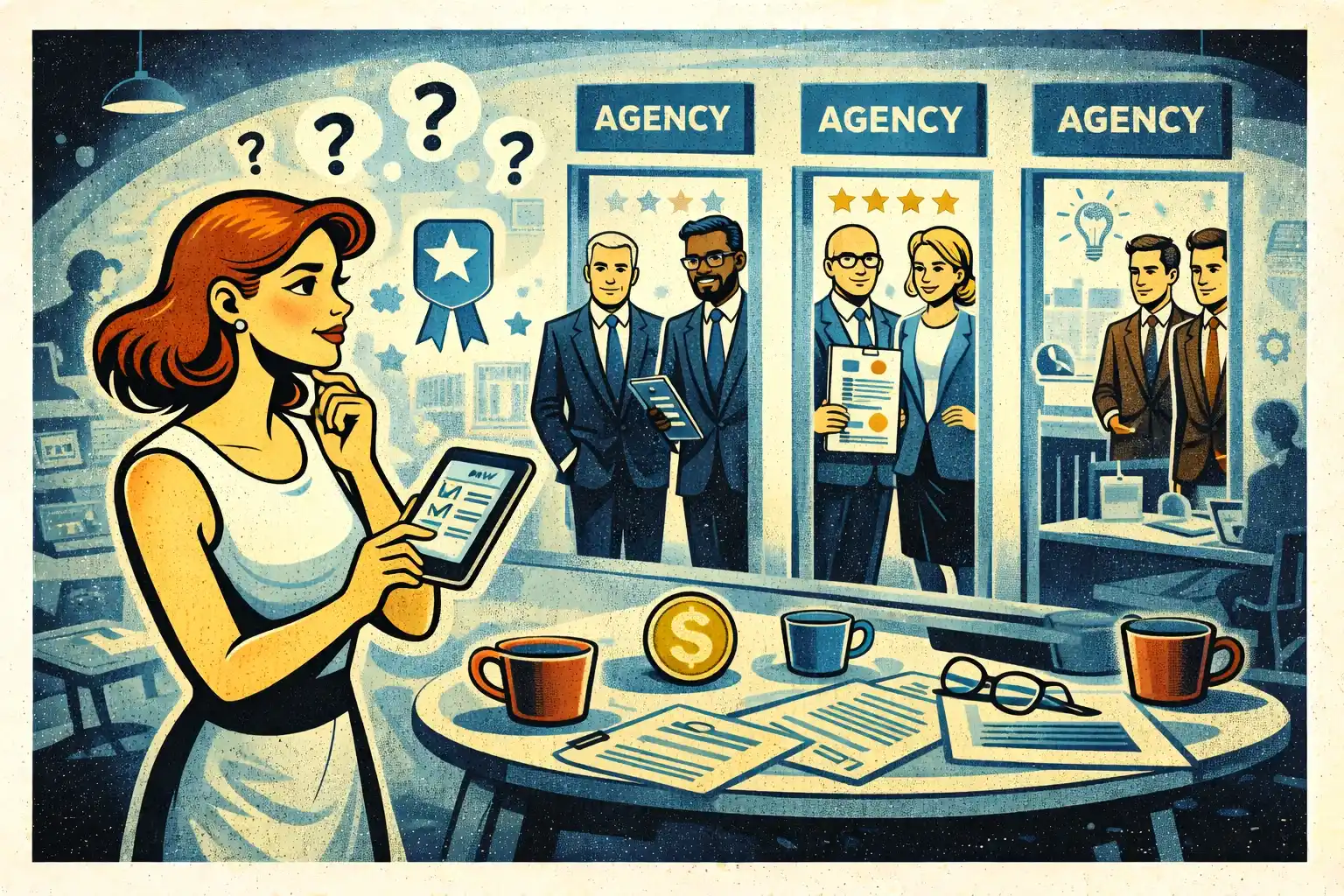
Choosing between a fractional CTO and a development agency is one of the fastest ways to either speed up your MVP — or burn months of runway. In 2026, both options look “easy” on paper, especially with AI tools in the mix. This guide explains what you actually get from each model, what can go wrong, and how to decide based on your stage, budget, and delivery expectations. You’ll also get a practical checklist to avoid common hiring traps.

TL;DR: Pick a fractional CTO when you need product and technical leadership, clear decision-making, and strong oversight of delivery. Pick an agency when you need a reliable team to design, build, and ship a defined scope fast. The safest setup for many non-technical founders in 2026 is “CTO-level guidance + a small delivery team,” but only if ownership, scope, and incentives are crystal clear.
The real question you’re answering
Most founders ask: “Who should I hire?”
The better question is: “What is my biggest risk right now?”
- If your risk is wrong decisions (scope, architecture, hiring, priorities), you need leadership.
- If your risk is slow execution (you can’t ship), you need a team.
In 2026, the tools can accelerate building, but they don’t remove the need for judgment and accountability. If you want a broader framework for decision-making this year, see Tech Decisions for Founders in 2026.
What a fractional CTO actually is in 2026
A fractional CTO is a part-time technical leader. In a good setup, they:
- Translate your business goals into an MVP plan
- Define architecture at the “right” level (not overkill)
- Set engineering standards (quality, security, performance)
- Review work, prevent bad technical debt, manage risk
- Help you hire and evaluate developers
What they typically do not do:
- Implement most features themselves
- Run design
- Deliver a full MVP end-to-end unless they also have a team
Think of them as your decision-maker and safety net — not your production line.
What an agency actually is in 2026
An agency is a delivery engine. In a good setup, they:
- Turn scope into UX/UI, build, QA, and ship
- Provide a predictable process (sprints, demos, releases)
- Handle multiple roles (design, frontend, backend, QA)
- Move faster than assembling freelancers from scratch
What they may struggle with:
- Deep product ownership (unless founder-led and hands-on)
- Saying “no” to your scope creep (because it increases billable work)
- Strategic tradeoffs if the brief is fuzzy
If you’re weighing agency vs other hiring models, this comparison helps: Startup App Development Company vs Freelancers vs In-House Team.
Quick comparison (without a table)
Instead of a table, here’s the clean mental model:
Fractional CTO is best for
- You’re non-technical and need someone to “own” technical decisions
- You’re hiring freelancers or a small team and need oversight
- Your product has tricky constraints (permissions, matching logic, compliance, scale)
- You keep changing priorities and need strong scope discipline
Agency is best for
- You already know what MVP you’re building (or can define it fast)
- You need speed and a full team to ship
- You want one contract instead of coordinating 3–6 people
- You can commit to a clear scope and iterate after launch
Costs: what founders underestimate
This is where most mistakes happen. Not because the hourly rate is wrong—but because founders don’t price in management load.
Fractional CTO cost reality
You pay for high-leverage time. The hidden costs are usually:
- Still needing developers/designers to build
- More time spent coordinating contractors
- Slower output if the CTO is also sourcing and managing the team
Fractional CTO is often cost-effective when it prevents big mistakes and rework. It becomes expensive when it turns into “part-time everything.”
Agency cost reality
You pay for a team and process. The hidden costs are usually:
- Misaligned incentives if scope is unclear
- Overbuilding if nobody is aggressively cutting MVP features
- Paying for project management you didn’t really need — or missing it when you do
If your budget is tight and you’re pre-seed (or bootstrapping), you’ll want a disciplined MVP cut. This is a useful baseline: Pre-Seed MVP Development for Unfunded Startups on a Budget.
The #1 failure mode for each option
Fractional CTO failure mode: “Great advice, no shipping”
You get strategy, docs, architecture… and still no product in users’ hands.
How to avoid it:
- Define a weekly output expectation (decisions made + delivery unblocked)
- Make sure there’s a delivery team attached (even small)
- Track progress by releases, not meetings
Agency failure mode: “Shipping the wrong thing fast”
You get velocity, but you launch something nobody uses — or something that’s hard to iterate.
How to avoid it:
- Lock an MVP boundary (what’s in / what’s out)
- Require a real feedback loop (events, dashboards, user testing)
- Make sure the agency can challenge your assumptions, not just execute them
If you want a practical lens on risk vs speed, read Full-Cycle MVP Development: From Discovery to First Paying Users.
When the hybrid setup wins in 2026
For many non-technical founders, the strongest setup is:
- Fractional CTO for decisions + oversight
- A small agency (or compact dev team) for delivery
It works when roles are clean:
- CTO owns architecture, code review standards, risk management
- Delivery team owns implementation and shipping
- Founder owns prioritization and business decisions (with help)
It fails when everyone is “kind of responsible” and nobody is accountable.
Red flags to watch (both sides)
Fractional CTO red flags
- Can’t explain tradeoffs in plain language
- Talks only about tools, not product constraints
- Avoids giving estimates or boundaries
- Pushes for over-engineering “just in case”
Agency red flags
- No pushback on scope (everything is “easy”)
- No clear ownership of code and design files
- Weak QA and vague launch plan
- Doesn’t ask about metrics, activation, or real users
If you want a deeper “what to ask before you sign” guide, see Outsource Development for Startups: Pros, Cons, and Red Flags.
The decision checklist (use this before you choose)
Ask yourself:
- Do I need leadership more than hands?If yes, start with fractional CTO.
- Can I clearly define the MVP scope in 1–2 weeks?If yes, an agency can ship fast.
- Do I have time to manage people weekly?If no, you want a team that includes product/delivery management.
- Is my product technically tricky?If yes, strong oversight matters more than speed.
- What would hurt more: shipping late or shipping wrong?Let that answer drive the model.
If you’re stuck because you have the idea but not the team, start here: I Have a Startup Idea but No Developer: What to Do Next.
Where AI fits into this choice
In 2026, everyone says “we use AI.” That’s not a differentiator.
What matters is whether AI is used to:
- Speed up delivery without lowering quality
- Reduce repetitive work (tests, scaffolding, docs)
- Improve iteration speed after launch
Not to:
- Replace decision-making
- Mask lack of engineering standards
- Ship unreviewed code straight to production
If you want a founder-friendly view of what AI can realistically save (and what it can’t), read AI-Powered MVP Development: Save Time and Budget Without Cutting Quality.
Thinking about building a web or mobile MVP in 2026?
At Valtorian, we help founders design and launch modern web and mobile apps — including AI-powered workflows — with a focus on real user behavior, not demo-only prototypes.
Book a call with Diana
Let’s talk about your idea, scope, and fastest path to a usable MVP.
FAQ
Is a fractional CTO enough to build my MVP?
Usually not by themselves. A fractional CTO is strongest when they provide leadership and oversight while a delivery team builds.
When is an agency the wrong choice?
When your scope is still fuzzy, priorities change weekly, or you don’t have anyone who can challenge decisions and enforce MVP boundaries.
Can I hire an agency and skip any CTO role?
Yes, if the agency is truly founder-led and provides strong technical leadership and product guidance. Otherwise you risk overbuilding or accumulating hard-to-fix tech debt.
What should I ask a fractional CTO before hiring?
Ask how they prevent over-engineering, how they define MVP boundaries, what artifacts you’ll own, and how they measure progress week to week.
What should I ask an agency before signing?
Ask about ownership of code/design, how scope changes are handled, QA and release process, and how they track activation and early user behavior.
What’s the safest setup for a non-technical founder with limited runway?
A small, accountable delivery team with clear scope plus CTO-level oversight (part-time is fine) is often the safest way to ship without expensive rework.































































.webp)




.webp)