.webp)
Startup App Development Company vs Freelancers vs In-House Team
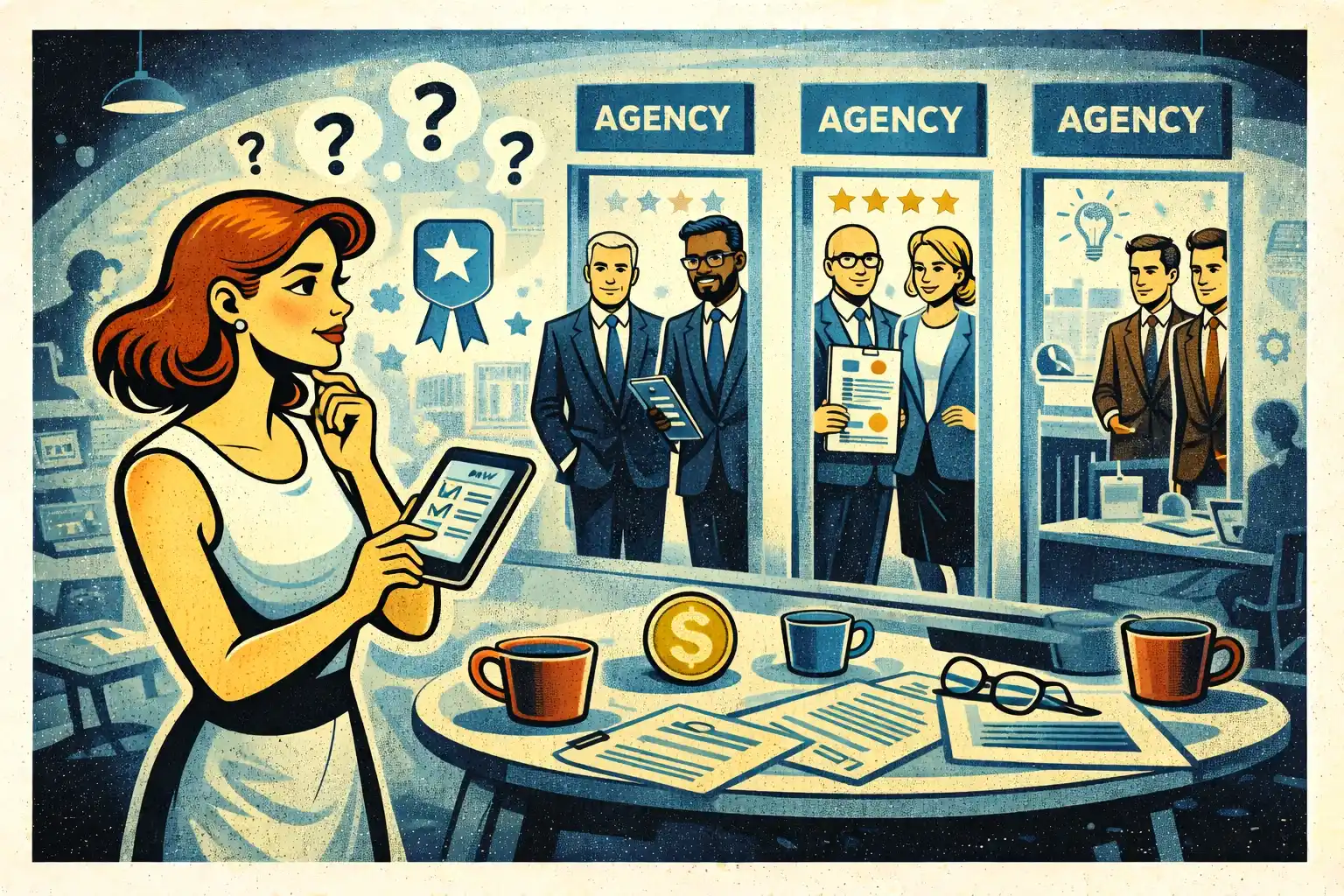
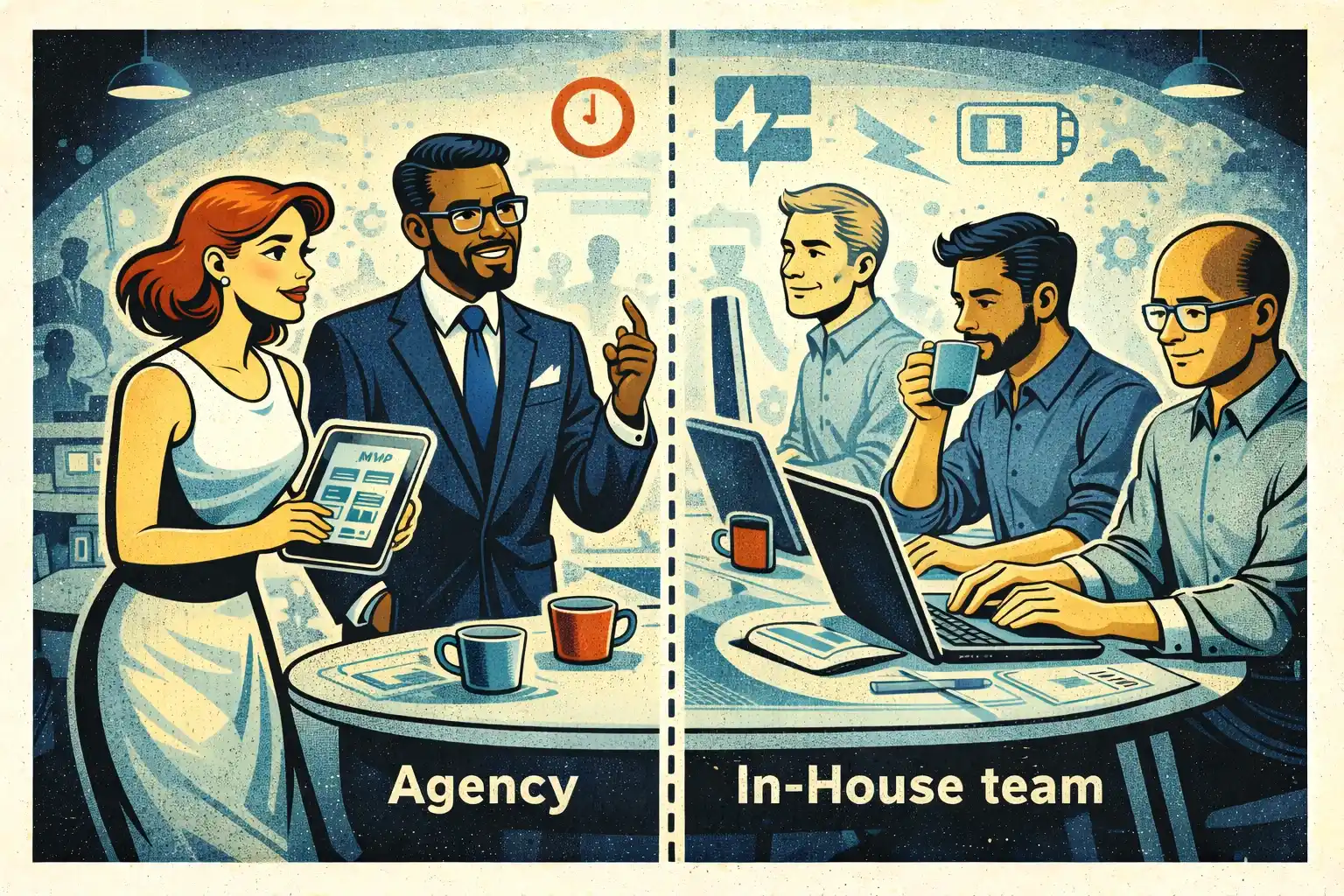
Founders often struggle to choose between hiring freelancers, building an in-house team, or partnering with a startup-focused development company. Each path has very different implications for speed, cost, and stress — and the wrong choice can delay your MVP by months. This guide breaks down the trade-offs in simple language so you can choose based on your stage, budget, and risk tolerance. You’ll see where each option shines, where it fails, and what makes the most sense for early-stage startups.

TL;DR: For most early-stage founders, a small senior app development company (boutique MVP studio) is the safest and fastest way to a real MVP. Freelancers are cheap but fragile and hard to coordinate, while in-house teams are powerful but too expensive and slow to assemble before product-market fit. Your decision should be based on process, reliability, and speed — not just hourly rates.
Why this decision matters more than tech stack
The team model you choose will directly affect:
- how fast you launch
- how much you spend before validation
- how clearly your idea becomes a working product
- how painful (or smooth) the journey feels
Most founders make the decision based on price or “who replied first”, instead of:
- process
- seniority
- accountability
- ability to say “no” to extra features
If you haven’t yet clearly defined what belongs in your MVP, start with “App Development for Non-Technical Founders: A Step-by-Step Guide” — it makes every team comparison more meaningful.
Option 1 — Freelancers
Freelancers can seem like the easiest way to “just get something built”.
Advantages of freelancers
- Lower up-front cost
Hourly or fixed prices are usually below agency rates. - Fast to start
You can find someone quickly and begin small tasks. - Great for isolated work
Landing page, logo, bug fixes, small features.
Risks and limitations
- No unified product vision
Designer, frontend dev, and backend dev may all think differently. Nobody owns the product holistically. - You become the project manager
You must coordinate tasks, check quality, track progress, handle priorities, and resolve conflicts. - Inconsistent quality and velocity
People have other clients, different standards, different availability. - No real QA or process
Unless you set this up yourself, you’ll discover bugs through users — not testing.
When freelancers make sense
- very simple products or prototypes
- clearly defined small tasks
- when you have strong product/tech management skills yourself
When freelancers are a bad idea
- multi-role products
- anything with compliance or sensitive data
- when you don’t want to manage the entire project alone
If you want to understand what layers are missing when you only hire freelancers, look at “MVP Development Services for Startups: What’s Actually Included” — it shows the full stack of work required for a proper MVP.
Option 2 — In-House Team
Hiring your own developers and designers is the “classic startup dream” — but often a terrible idea at the idea/MVP stage.
Advantages of an in-house team
- Full control
You can prioritize, re-prioritize, and iterate as often as you like. - Long-term alignment
People feel ownership and can stay for years. - Fast iteration after product-market fit
Once you know what works, an in-house team is great for rapid scaling.
Downsides (especially early on)
- Very expensive before validation
Even a small team (2–3 engineers + designer) quickly reaches tens of thousands per month. - Slow to assemble
Hiring takes weeks or months, plus onboarding. - You need technical leadership
Without a CTO or experienced architect, in-house teams can drift and accumulate technical debt fast. - High commitment for an unproven product
You’re essentially betting your entire runway on one product direction.
When in-house is a good choice
- you already have traction and paying users
- you’ve raised a meaningful round
- you understand your roadmap for the next 12+ months
When in-house is a bad choice
- at idea stage
- at “we’re not sure what users really want yet” stage
- when budget is still limited
For cost perspective, “MVP Development Cost in 2025: How Much Does It Really Cost?” shows why in-house version one is often 3–5× more expensive than working with a focused MVP team.
Option 3 — Startup App Development Company (Boutique MVP Studio)
This is the option specifically suited for early-stage startups and non-technical founders.
We’re not talking about a large outsourcing company with 200 people.
We’re talking about small, senior, founder-led studios that:
- build only MVPs/startups
- work directly with founders
- think like product strategists, not just developers
Advantages of a boutique MVP company
- Senior team from day one
You work with people who have already gone through the “idea → MVP → first users” cycle dozens of times. - Clear process
Discovery → UX → UI → development → QA → launch → post-launch fixes. - No need for a technical cofounder at the start
The studio covers this role temporarily. - Fast delivery (4–8 weeks)
Fewer handoffs, less politics, more focus. - Better cost-to-result ratio than in-house
You pay for delivered outcomes, not full-time salaries. - Higher accountability than freelancers
A company has reputation, history, and client expectations behind it.
Disadvantages
- Limited capacity
The best studios work with only a few clients at once. - Not a forever solution
After traction, it becomes logical to build an internal team.
When this is the best option
- you are a non-technical founder
- you need an MVP in 4–8 weeks
- you don’t want to manage developers
- you want transparency in budget and process
If you’re building a product in fintech or healthcare, make sure the company understands compliance — “Fintech and Healthcare MVP Development: How Compliance Changes the Plan” gives important context.
Comparison Without a Table: How They Stack Up
Speed of Launch
- Freelancers: Medium — depends on how fast you find the right people and how well they coordinate.
- In-house: Slow — recruiting + onboarding + forming a workflow.
- Boutique company: Fast — established processes and a synchronized team.
Cost (for MVP)
- Freelancers: Cheapest upfront, but often expensive in rework.
- In-house: Most expensive until traction.
- Boutique company: Middle — more than freelancers, far less than full-time hires.
Risk
- Freelancers: High — no unified product owner, no QA.
- In-house: Medium — expensive if the product doesn’t take off.
- Boutique company: Low — experienced team, process, accountability.
Fit for early-stage founders
- Freelancers: Good for ultra-simple prototypes.
- In-house: Poor — too slow and too expensive.
- Boutique company: Ideal for MVPs and first users.
As soon as your product grows, you may shift to an in-house team, while the studio remains a strategic or architectural partner.
How to choose the model if you're a non-technical founder
Ask yourself:
1. Do I know what v1 must actually do?
If not, clarify this first — “App Development for Non-Technical Founders: A Step-by-Step Guide” helps structure it.
2. Do I want to personally manage developers?
If no — freelancers are not an option.
3. Do I have the budget and traction for a full-time development team?
If no — in-house is premature.
4. How important is it to launch quickly?
If speed is critical — a senior boutique studio is the best fit.
5. Does my product involve compliance or sensitive data?
If yes — you need a team with domain experience, not a random set of freelancers.
Still unsure whether you need freelancers, an in-house team, or a development company?
At Valtorian, you work directly with the founders — a designer and a developer who’ve shipped 70+ MVPs for non-technical founders. We help you choose the right model for your stage, define a lean scope, and launch a production-ready MVP in 4–6 weeks.
Book a call with Diana
We’ll review your idea, compare your options honestly, and outline the most efficient path to your first version.
FAQ — Freelancers vs Development Company vs In-House Team
What’s the best choice for early-stage MVPs?
Usually a small, senior MVP development company — fast, structured, and focused on outcomes.
Are freelancers always a bad idea?
No. They’re fine for simple tasks and prototypes. They’re risky as the main engine of your MVP.
When does it make sense to build an in-house team?
After you’ve validated the product, have paying users, and a clear roadmap for the next 12+ months.
Do I need a CTO before choosing a team?
No. For an MVP, you don’t. A CTO becomes necessary once you have a stable product and long-term technical strategy.
Why are large agencies often a bad fit for startups?
They are slow, expensive, and involve many handoffs. For MVPs, this overhead is unnecessary.
Can I start with a studio and move to in-house later?
Yes — this is the standard and healthiest path. The studio builds v1, and once you have traction, you grow an internal team.
What if my product is in fintech or healthcare?
Then your team must understand compliance and data security. Freelancers are particularly risky here.






















































.webp)




.webp)