.webp)
Web vs Mobile First in 2026: A Founder Framework
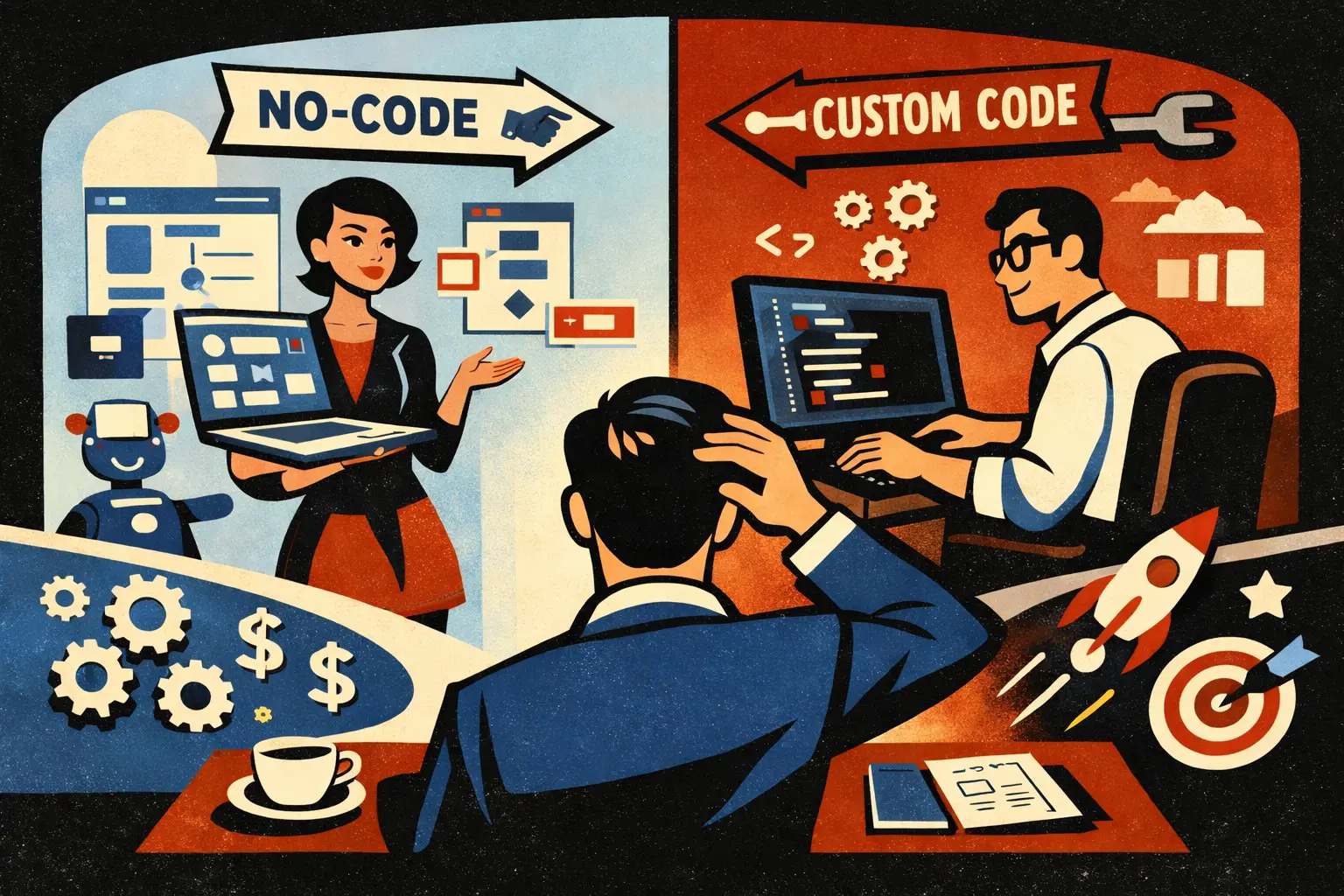
Choosing web vs mobile first is not a “tech preference” decision — it’s a business decision that affects speed, cost, distribution, and retention. In 2026, tools and AI make both paths feel easier, but the wrong choice still burns runway through rework, slow iteration, or poor adoption. This article gives non-technical founders a clear framework: when web wins, when mobile wins, and how to pick based on user behavior, monetization, and product constraints. You’ll also get a simple decision checklist and common traps to avoid.

TL;DR: If you need fast iteration, easy sharing, and lower initial complexity, go web first. If your product depends on native behavior (push, camera, location, offline), strong habitual use, or App Store distribution, go mobile first. In 2026, many founders start with web for validation and switch to mobile once the core loop proves retention — but the best path depends on your users, not your preferences.
Start with the real question: where will users meet your product?
Founders often treat this as a technical debate. It isn’t.
The correct starting point is distribution:
- Will users discover you via links (social, SEO, partners, communities)?
- Or will they discover you via the App Store / Play Store?
- Do you need to share instantly (a link) or install is acceptable?
If you want a broad lens on founder decisions this year, read Tech Decisions for Founders in 2026.
What “web first” means in 2026
Web first usually means a responsive web app (often with a dashboard) that can run on desktop and mobile browsers.
Web first tends to win when:
- Your MVP needs to iterate fast (weekly learning)
- Your users are already working on desktop (B2B, admins, ops)
- Sharing and onboarding must be frictionless (open link - try it)
- You want easier analytics and faster releases
If your MVP is marketplace-style, web can be a strong first step because it helps you manage supply/demand operations faster. For feature discipline in marketplaces, see Marketplace MVP Development for Startups: Features You Actually Need.
What “mobile first” means in 2026
Mobile first means the primary experience is iOS/Android from day one.
Mobile first tends to win when:
- The product is used on the go (daily habit, quick actions)
- You need native capabilities (push notifications, camera, Bluetooth, background tasks)
- The user experience must feel “app-native” (smooth gestures, offline mode)
- Your growth model relies on App Store presence, ASO, or mobile referrals
Speed: what’s actually faster to ship
In practice, “faster” depends on your scope and your decision-making.
Web speed advantages
- Faster release cycles (deploy anytime)
- Fewer store constraints and review delays
- Easier A/B testing and iteration
Mobile speed advantages
- Stronger native UX out of the box
- Better push and retention mechanics early
- More consistent performance on modern devices
The hidden truth: mobile feels slower when your scope is unstable, because every change ripples through builds, QA, and releases.
Cost: the founder-reality version
Cost isn’t just development cost. It’s also iteration cost.
- Web first often lowers the cost of learning (ship - measure - adjust)
- Mobile first can raise the cost of learning if you’re still searching for the core loop
If you want a plain-language view of cost tradeoffs, see App Development Cost for Startups: Web vs Mobile vs SaaS.
Retention and habit: where mobile usually wins
If your product needs frequent return behavior (daily/weekly), mobile has structural advantages:
- Push notifications
- Home screen presence
- Faster re-entry and “micro-usage” sessions
But mobile doesn’t magically create retention.
Retention still comes from:
- A clear user promise
- A fast path to value
- A core loop that repeats naturally
UX complexity: where web usually wins
Web can be simpler for:
- Admin panels and dashboards
- Multi-step forms
- Complex data views (tables, filters, analytics)
Mobile can be simpler for:
- Single-purpose flows
- Capture-first experiences (camera, quick input)
- Habit loops and notifications
If your product requires a serious dashboard, web-first is often the cleanest start.
Technical constraints: the parts founders don’t see
Here are the real constraints that change the decision.
Choose mobile first if you need
- Push notifications as a core feature
- Camera scanning / photo capture as a core action
- Location tracking or real-time movement
- Offline-first behavior
- Deep device integrations
Choose web first if you need
- SEO discovery
- Fast onboarding through links
- Complex admin workflows
- Multi-role dashboards (owner/admin/operator)
- Rapid iteration with fewer release constraints
Platform strategy: one platform first vs two at once
Many founders try to launch web + iOS + Android simultaneously.
That’s often the fastest way to slow down.
A practical 2026 strategy is:
- Start with one primary platform (based on distribution + core behavior)
- Launch, measure, then expand
If you’re bootstrapping, scope discipline matters even more. See How to Prioritize Features When You’re Bootstrapping Your Startup.
The “founder framework” decision checklist
No tables — so here’s a clean set of questions.
Where will users discover you?
- Links/SEO/communities → web-first advantage
- App stores/ASO/mobile referrals → mobile-first advantage
What is the core action?
- Long-form work / data-heavy workflows → web
- Quick, repeatable micro-actions → mobile
Do you need native features for the MVP?
If yes, mobile-first.
How stable is your MVP scope?
- Unstable and exploratory → web-first
- Clear and validated → mobile-first is safe
What hurts more: slow iteration or weaker retention?
Answer honestly. That’s your platform decision.
Common traps to avoid
Trap 1: Choosing based on what you personally prefer
Your users may behave differently.
Trap 2: “We need mobile because it feels more real”
A web MVP can be very real if it solves a real problem and reaches users.
Trap 3: Building all platforms before you have proof
You’ll spend budget multiplying the same uncertainty.
Trap 4: Overbuilding architecture early
Platform is not your biggest risk early — clarity and adoption are.
If you want a guide to avoid early-stage mistakes, read MVP Development for Non-Technical Founders: 7 Costly Mistakes.
A practical path many founders use in 2026
A common, sensible path:
- Web MVP for fast validation and iteration
- Mobile app once the core loop and retention are proven
But don’t treat this as a universal rule. If your product depends on mobile-native behavior, start mobile.
Thinking about building a web or mobile MVP in 2026?
At Valtorian, we help founders design and launch modern web and mobile apps — including AI-powered workflows — with a focus on real user behavior, not demo-only prototypes.
Book a call with Diana
Let’s talk about your idea, scope, and fastest path to a usable MVP.
FAQ
Is web always cheaper than mobile?
Often it’s cheaper to start learning on web because iteration is faster. But if your MVP needs native features, mobile-first may be cheaper than building web twice.
Can I start with a web app and later build mobile without rewriting everything?
Yes if your backend, data model, and permissions are clean. But you’ll still rebuild the UI for mobile.
What if I need both web and mobile in MVP?
Start with the platform that enables real usage and learning first. Add the second platform once your core loop proves adoption.
Does mobile-first help with retention?
It can, because push and home screen presence help. But retention still depends on the core value and user habit loop.
Is a PWA a good compromise?
Sometimes. A PWA can reduce install friction and feel app-like, but it won’t fully replace native capabilities (especially around push, background tasks, and platform-specific behaviors).
How do I decide if my product is “mobile-native”?
If the MVP requires camera/location/offline/push as a core action—not as a nice-to-have—you’re likely mobile-native.
What should I prepare before choosing a platform?
Clarify your primary user, core action, distribution channel, and MVP boundary. Platform should support those decisions, not replace them.

















































.webp)




.webp)