.webp)
React Native Development Cost in 2025: How Much Does It Really Cost?
React Native remains one of the most popular choices for startups building cross-platform mobile apps, but many founders still underestimate its real cost. In 2025, React Native development is no longer just about saving money — it’s about speed, maintainability, and making smart trade-offs early. This guide breaks down what actually affects React Native development cost, what founders usually miss when budgeting, and how to approach pricing realistically without overbuilding or burning runway.

TL;DR: In 2025, React Native app development typically costs less than building two separate native apps, but it’s not “cheap by default.” Real costs depend on backend complexity, integrations, roles, and scope discipline. Most startup MVPs fall into a wide but predictable range when built correctly — and exceed it quickly when overbuilt.
Why founders still misjudge React Native costs
Many non-technical founders assume React Native automatically means:
- half the cost of native development
- faster timelines no matter what
- fewer engineers needed
In reality, React Native reduces frontend duplication, not overall product complexity.
If your MVP scope isn’t clear, React Native won’t save you.
Before budgeting anything, it helps to understand the full MVP structure. “MVP Development Services for Startups: What’s Actually Included” explains why mobile apps are much more than UI screens.
What actually drives React Native development cost
React Native cost is shaped by decisions, not frameworks.
1. App complexity (not screen count)
A 10-screen app can be more expensive than a 30-screen app if it includes:
- complex business logic
- multiple user roles
- real-time updates
- offline mode
- background tasks
2. Backend scope
React Native only covers the client side.
Your backend may include:
- authentication and roles
- APIs and business logic
- database structure
- admin dashboards
- third-party integrations
Backend complexity is often the largest cost driver.
For architecture clarity, “Web App Development for Startups: Architecture Basics for Non-Tech Founders” is a useful reference.
Typical React Native MVP cost ranges in 2025
Instead of fixed numbers, think in tiers:
Lean MVP
- one primary user role
- single core flow
- minimal backend logic
- basic UI
This is the fastest and most cost-efficient path.
Standard Startup MVP
- 2–3 user roles
- backend logic and integrations
- authentication and permissions
- polished UI/UX
Most funded startups fall here.
Complex MVP
- real-time features
- payments and subscriptions
- advanced analytics
- compliance requirements
Costs rise quickly at this level.
If you want a broader comparison across platforms, “App Development Cost for Startups: Web vs Mobile vs SaaS” gives helpful context.
React Native vs native iOS/Android — cost perspective
React Native saves money mainly by:
- sharing one codebase
- reducing duplicate frontend work
- simplifying feature parity across platforms
But it does not reduce:
- backend development
- product design work
- QA and testing effort
- product management time
If your app is highly platform-specific, native may still be better.
For a deeper technical comparison, see “React Native vs Flutter for Startup App Development in 2025”.
Hidden costs founders often ignore
1. Overengineering too early
Adding:
- notifications
- advanced dashboards
- complex onboarding
before validation inflates cost without increasing learning.
This mistake appears frequently in “MVP Development for Non-Technical Founders: Common Mistakes”.
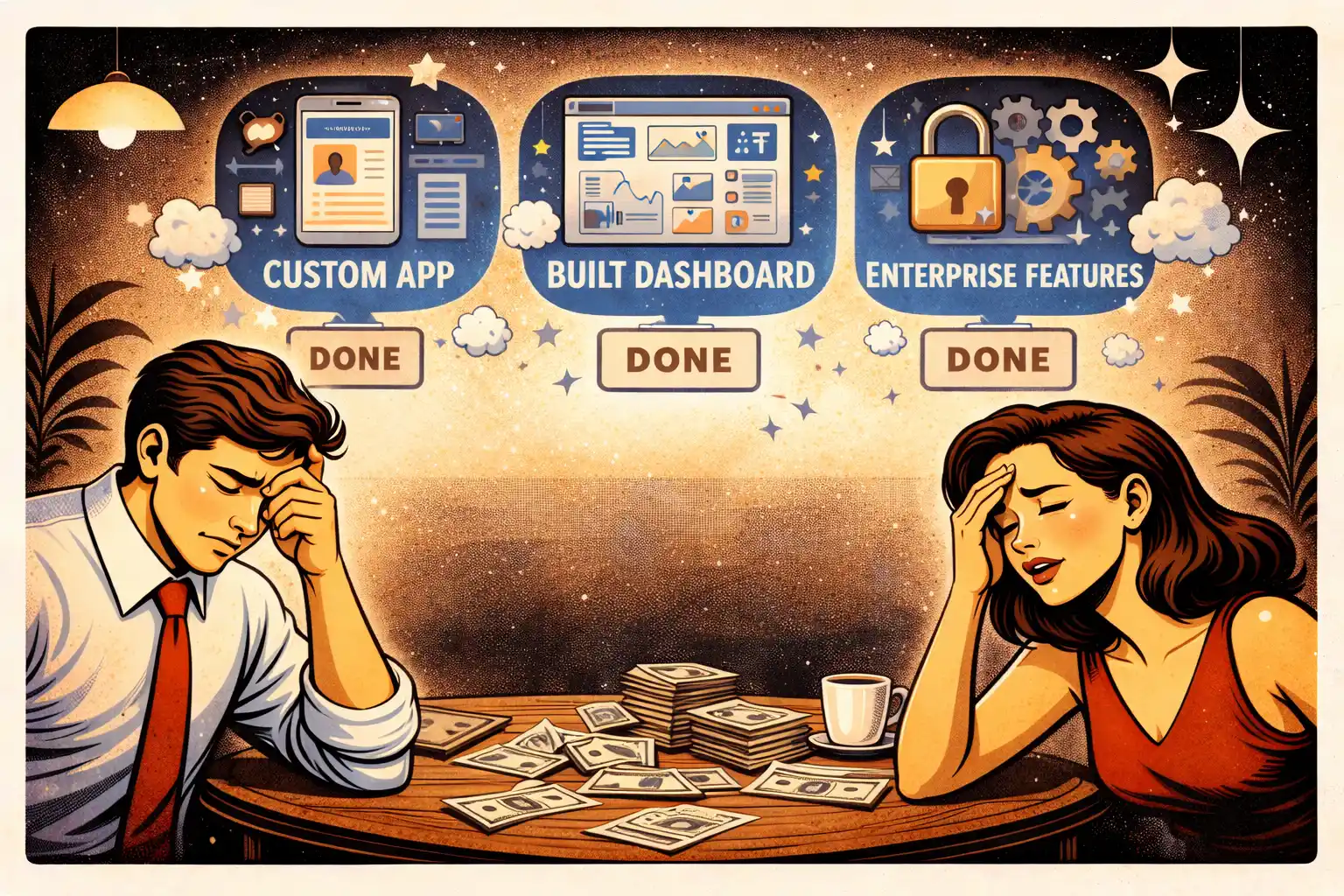
2. Poor scope control
Changing requirements mid-development leads to:
- timeline creep
- rework
- budget overruns
3. Cheap teams with high rework cost
Low hourly rates often mean:
- unclear architecture
- poor testing
- expensive fixes later
How AI is affecting React Native development cost
In 2025, AI-assisted development helps reduce cost by:
- speeding up boilerplate coding
- catching bugs earlier
- improving test coverage
- accelerating UI iterations
But AI doesn’t replace senior judgment.
If used incorrectly, it increases complexity instead of reducing it.
“AI-Powered MVP Development: Save Time and Budget Without Cutting Quality” explains where AI actually helps — and where it doesn’t.
How to budget React Native development realistically
Before asking for estimates, make sure you have:
- a clear MVP scope
- defined user roles
- one primary user journey
- understanding of backend needs
If you’re still at idea stage, “App Development for Non-Technical Founders: A Step-by-Step Guide” helps you prepare properly.
Clear inputs = predictable pricing.
When React Native is the right choice
React Native is ideal when:
- you need iOS and Android quickly
- your product logic is shared across platforms
- speed matters more than deep native customization
- you’re building an MVP or v1
When it’s not
React Native may not be ideal if:
- your app depends heavily on platform-specific features
- you need advanced low-level native APIs
- performance constraints are extreme
Final takeaway
React Native is not a shortcut — it’s a multiplier.
With the right scope and team, it reduces cost and time.
With poor planning, it becomes just as expensive as native — sometimes more.
The difference is not the framework.
It’s how you approach the MVP.
Not sure how much your React Native app should actually cost?
At Valtorian, we help founders scope React Native MVPs realistically — cutting unnecessary features, choosing the right architecture, and avoiding budget traps.
Book a call with Diana
We’ll review your idea and give you a clear, honest cost range.
FAQ — React Native Development Cost
Is React Native cheaper than native apps?
Often yes — but only when scope is controlled.
What’s the biggest cost driver?
Backend logic and integrations, not UI.
Can React Native scale after MVP?
Yes. Many large apps started with React Native.
Does AI reduce React Native cost?
Yes, when guided by senior engineers.
How long does a React Native MVP take?
Typically 4–8 weeks for a focused scope.
Should I choose React Native or Flutter?
Depends on team expertise and product needs.
Can I convert a web MVP into React Native later?
Yes, but plan architecture early.































































.webp)




.webp)