.webp)
MVP Development Cost in 2025: How Much Does It Really Cost?
How much should a startup realistically expect to pay for an MVP in 2025? The internet is full of vague ranges — from $5k to $250k — leaving founders confused and unable to plan. This guide breaks down the real factors behind MVP pricing: scope, design, development, integrations, compliance, team structure, and timeline. By the end, you’ll understand what influences cost, what’s included in a proper MVP package, and how to budget without burning half your runway before testing real user demand.

TL;DR: Most startup MVPs in 2025 cost between $10,000 and $40,000, depending on complexity, platform (web, iOS, Android), design requirements, and integrations. Very simple MVPs can cost less, while multi-platform, data-heavy, or AI-driven products cost more. But the biggest cost driver isn’t features — it’s clarity. Well-scoped MVPs stay cheap; vague MVPs balloon in price.
Why MVP prices vary so dramatically
Two founders can present “the same idea” and receive estimates that differ by 5–10×.
The difference comes from:
- how much is included (UX, UI, QA, analytics, launch support)
- how complex the flows are
- how many screens and roles exist
- how custom the UI needs to be
- how many external systems you integrate
- how many platforms you build (web, iOS, Android)
- compliance or security requirements
Before we go further, here’s an important truth:
The cheapest MVPs are built on scope clarity, not minimal features.
If you aren’t fully clear on your MVP scope, read our article “App Development for Non-Technical Founders: A Step-by-Step Guide” — it explains how to define your first user flow and avoid bloated MVPs.
Realistic MVP Pricing Ranges for 2025
1. Ultra-Lean MVP ($5,000–$12,000)
Best for founders who need the simplest possible version to validate demand.
Typical use cases:
- single booking flows
- small CRUD apps
- very simple two-sided interactions
- internal workflow tools
- prototypes for investors
Includes:
- basic UX
- simple UI
- 3–6 core screens
- one primary end-to-end flow
- minimal backend
- basic admin access
Excludes:
- advanced dashboards
- multi-platform apps
- AI modules
- multiple user roles
- complex automation
2. Standard MVP (Most Common) — $15,000–$30,000
This is where most serious early-stage startups land.
Typical use cases:
- marketplaces
- SaaS dashboards
- scheduling platforms
- messaging or collaboration tools
- apps with payments or subscriptions
- early-stage mobile apps
Includes:
- full UX mapping
- UI design
- 8–20 screens
- backend + database
- authentication
- role-based access
- 1–2 integrations (Stripe, email, notifications)
- event tracking & analytics
- QA + testing
- launch support
If you want to understand the full structure of a proper MVP service, read “MVP Development Services for Startups: What’s Actually Included” — it breaks down every stage of the process.
3. Complex MVP ($30,000–$60,000)
For startups needing more robust architecture in version one.
Includes:
- multi-role access
- multi-platform (web + iOS + Android)
- advanced dashboards
- workflow-heavy systems
- integrations with external ERPs, CRMs, or providers
- compliance considerations
Typical products:
- healthcare tools
- fintech or financial dashboards
- logistics & tracking systems
- real-time data apps
4. AI-Driven MVP ($40,000–$80,000+)
AI significantly increases cost because it requires:
- more backend logic
- model prompting or fine-tuning
- data preprocessing
- infrastructure for inference
- additional testing for output reliability
Common AI MVPs:
- recommendation systems
- AI assistants trained on internal knowledge
- OCR + automated extraction
- predictive analytics
If AI is a core value prop, expect the MVP to start around $40k.
What Actually Drives MVP Cost
1. Number of user flows
Not screens — flows.
Flows define effort.
2. UI complexity
Simple UI → affordable.
Custom, animated UI → more expensive.
3. Integrations
Stripe, Google Calendar, Maps, Twilio, AI APIs, etc. each add effort.
4. Platforms
Web only = cheapest.
Web + iOS + Android = 2–3× cost.
5. Compliance
Healthcare, fintech, education → require stricter practices.
6. Scope clarity
This is the biggest cost driver.
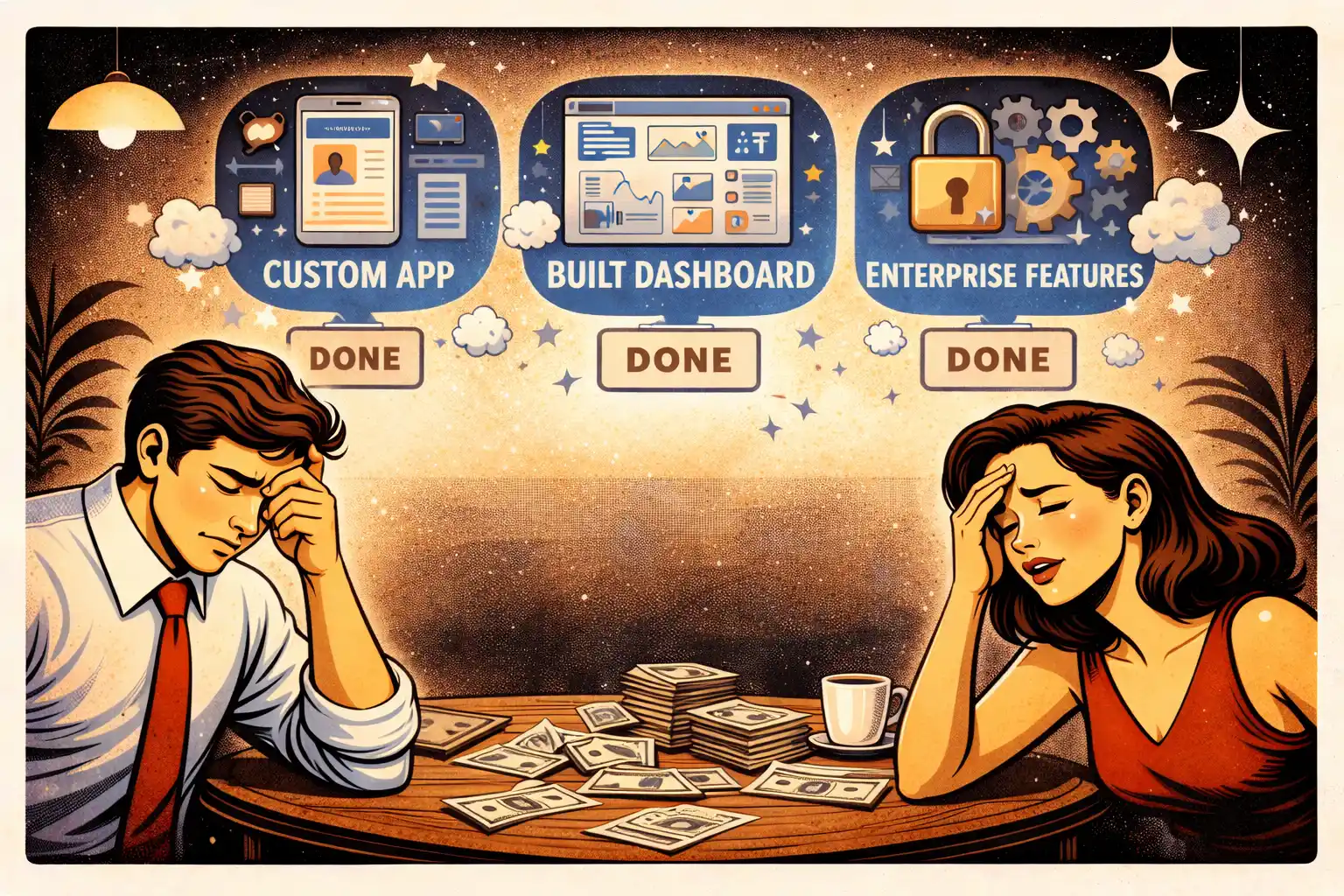
Unclear scope = endless revisions = higher cost.
How MVP Teams Price Projects
Good teams base pricing on:
- number of flows
- design complexity
- development effort
- integrations
- delivery timeline
- post-launch support requirements
Cheaper teams often exclude:
- UX research
- UI design
- QA
- analytics tracking
- launch support
And that’s why they cost less — they simply deliver less.
How to Reduce MVP Cost Without Sacrificing Quality
1. Focus on ONE core workflow
Everything else can wait for v2.
2. Limit user types
Most MVPs need only User + Admin.
3. Start with one platform
Web-first is often enough.
4. Keep UI simple
Clean → not overdesigned.
5. Avoid unnecessary integrations
If something can be done manually early on, do it manually.
6. Lock the scope early
Scope creep is the #1 cost killer.
Hidden or Ongoing Costs Founders Forget
Hosting
$30–$150/month depending on traffic.
Analytics
Some free, some $20–$50/month.
Maintenance
$500–$2,500/month depending on activity.
Future development
MVP is only step one — not the final product.
What Budget Should Startups Plan For in 2025?
Lean MVP: $10,000–$15,000
Most Common Range: $20,000–$30,000
Complex or AI-Heavy MVP: $40,000–$60,000+
If someone quotes you $3k for a “full MVP”, it’s not an MVP — it’s a template.
Ready to build your MVP with a small, senior team instead of hiring a full tech department?
At Valtorian, you work directly with the founders — a designer and a developer who have delivered 70+ products and helped non-technical founders launch fast, clearly, and without chaos.
If you want clarity on what your MVP should include, how long it will take, and what your realistic cost will be — let’s talk.
Book a call with Diana
We’ll review your idea, estimate complexity, and outline the most cost-efficient MVP path.
FAQ — MVP Development Cost in 2025
Why do MVP costs differ so much between agencies?
Because different teams include different components. Some only code; others include UX, UI, QA, analytics, and launch support.
What’s the absolute minimum for a real MVP?
Around $5k–$10k, but only for extremely simple apps with one core flow.
What influences cost the most?
Number of flows, design complexity, integrations, platform count, and how clearly the MVP is defined.
Should I build web or mobile first?
Web is usually cheaper and faster unless your product truly requires mobile use.
Does adding AI increase the price?
Yes — AI requires additional infrastructure, testing, data handling, and backend logic.
What does maintenance cost after launch?
Typically $100–$300/month for hosting and tools, plus optional development retainer if you need rapid updates.
Can I reduce MVP cost without reducing quality?
Absolutely: simplify flows, reduce roles, avoid custom animations, start with one platform, and limit integrations.
























































.webp)




.webp)