.webp)
AI Reliability in 2026: How to Avoid Bad Outputs
AI features can make an MVP feel magical — until the first bad output breaks user trust. In 2026, most failures aren’t about the model being “weak,” but about product workflows that allow unpredictable behavior: unclear inputs, long context, no validation, and no fallback. This article explains founder-friendly reliability patterns: how to structure AI steps, add guardrails, test outputs, and ship safely without turning your MVP into an enterprise compliance project. The goal is simple: predictable value, fewer surprises, and a clear path to improvement.
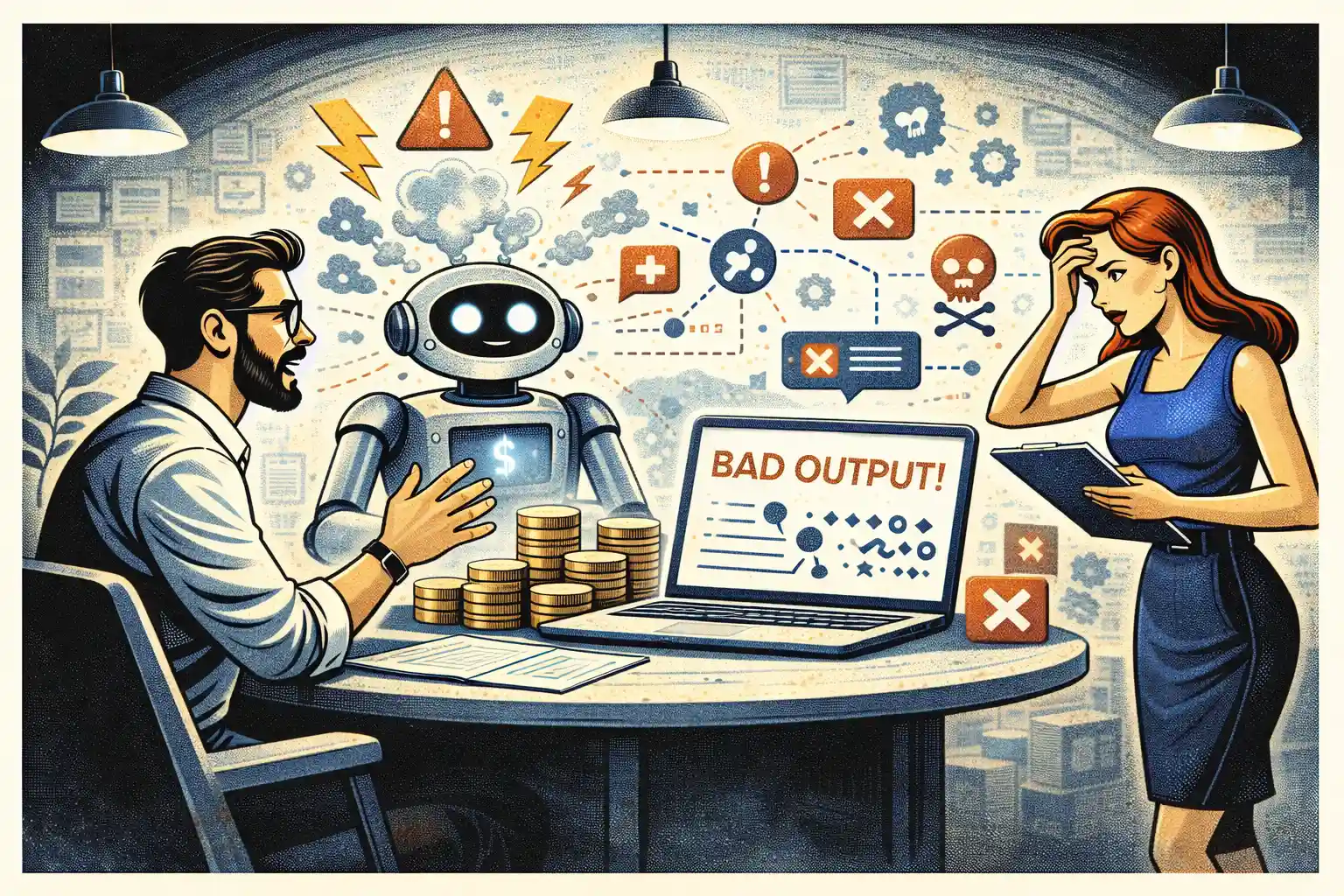
TL;DR: Bad outputs are usually a workflow problem, not a model problem. In 2026, reliability comes from narrowing the AI job, using structured inputs/outputs, validating results, and having a fallback when the AI fails. If you can’t measure “good vs bad,” you can’t improve reliability — so start with a few outcome-focused checks and iterate weekly.
Why reliability matters more than “AI wow”
Founders often worry about whether the AI is impressive.
Users care about whether it’s dependable.
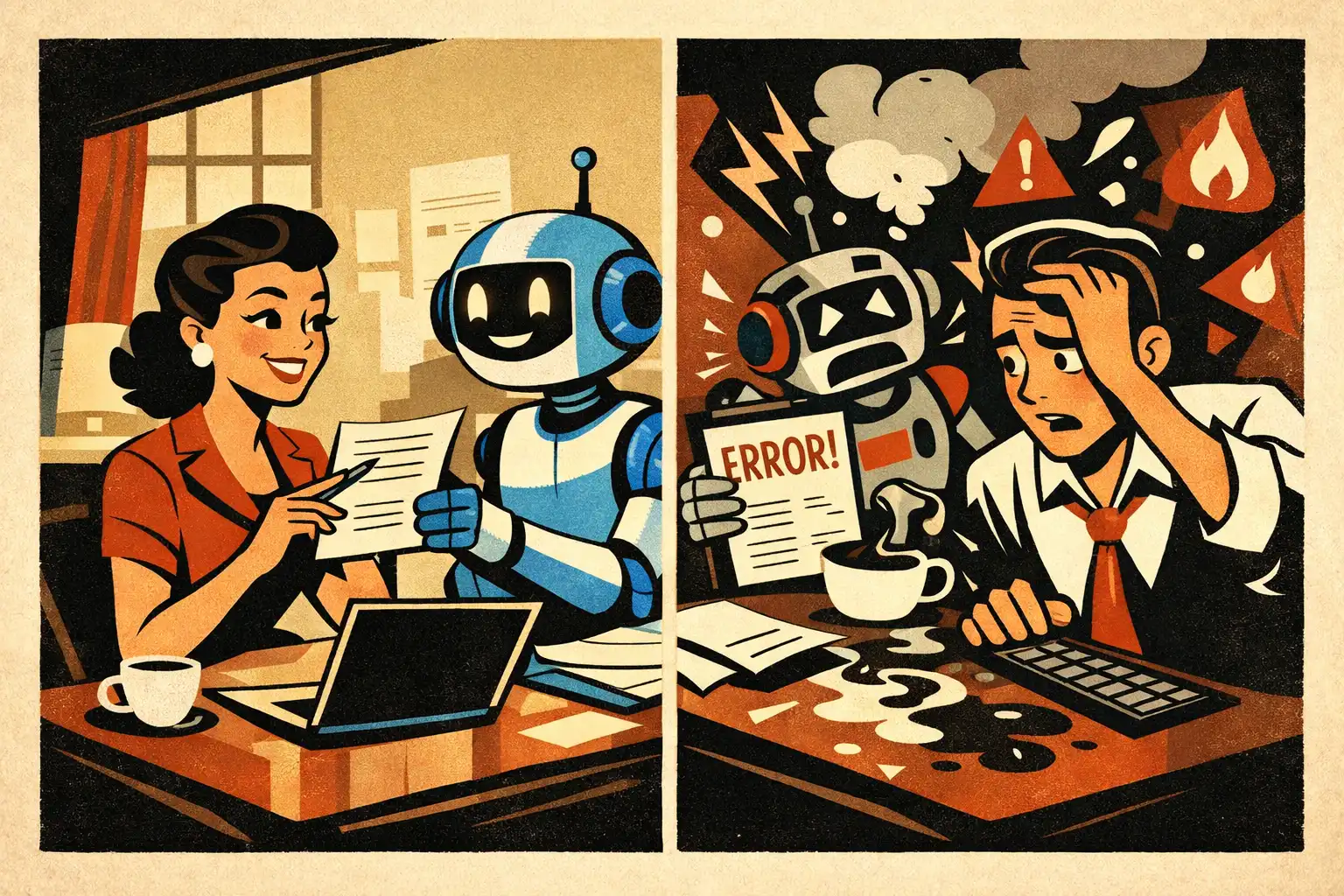
One bad output can:
- destroy trust
- increase support load
- force manual cleanup
- create screenshots that spread (in the wrong way)
The core idea: reliability is a product design problem
A model can be strong and still produce bad outputs if:
- the prompt is vague
- inputs are messy
- the model is asked to do too much
- there’s no verification step
- failures have no fallback
So the first step is not “switch models.”
The first step is to reduce uncertainty.
If you’re still deciding what AI feature is worth building in the first place, start with AI MVP Features in 2026: What’s Worth Building.
The 6 reliability failure modes you’ll see in MVPs
No tables — just the patterns.
1) Vague job definition
If the AI is asked to be “smart,” it will improvise.
Fix:
- give it a narrow job
- define success in one sentence
- reduce open-ended freedom
2) Uncontrolled inputs
Bad input produces bad output.
Fix:
- constrain user input with options
- validate required fields
- guide users with examples
3) Overlong context
Long context increases cost and error rate.
Fix:
- store state outside prompts
- send only what’s needed
- summarize deliberately instead of dumping history
4) No output structure
If output isn’t structured, it’s hard to validate.
Fix:
- enforce JSON or schema-like structure
- use a fixed format the product can parse
5) No verification
The AI outputs something, the product trusts it blindly.
Fix:
- validate against rules
- check constraints (length, allowed values, forbidden claims)
- add consistency checks
6) No fallback path
If AI fails, the user hits a dead end.
Fix:
- allow edits
- provide a “manual mode”
- provide a safer default recommendation
If you like the manual-first approach as a reliability strategy, this is the full playbook: Manual-First MVPs in 2026: What to Do Before Automating.
The reliability stack for AI MVPs (practical patterns)
Pattern 1: Narrow the AI job to one step
Instead of “generate the full solution,” break it down:
- extract intent
- classify
- draft
- refine
- format
But be careful: more steps can increase cost.
The trick is to split only when it reduces failure.
Pattern 2: Use structured outputs you can validate
Even for non-technical founders, the concept is simple:
- AI returns a predictable format
- Your app checks it
- If it fails checks, you retry or fall back
This reduces “randomness” and makes quality measurable.
Pattern 3: Add deterministic guardrails
Use rules for what rules are good at:
- required fields
- allowed ranges
- prohibited content
- formatting constraints
Let AI handle the fuzzy parts.
Pattern 4: Build idempotent retries
When AI fails, retries should be controlled:
- retry with tighter instruction
- reduce context
- change strategy (summarize first, then generate)
Don’t loop retries endlessly. Cap them.
Pattern 5: Keep a human-safe fallback
A fallback is not a weakness.
It’s how you protect trust.
Fallback options:
- manual templates
- “assistant draft” + user edit
- human review queue
- conservative default
Measuring reliability (without overbuilding)
You can’t improve what you don’t measure.
At MVP stage, measure reliability with:
- user correction rate (how often users edit or redo)
- retry rate
- failure reasons (invalid output, blocked by rule)
- time-to-value
Pair this with basic product analytics so you see where reliability affects activation and retention.
Use this event framework: MVP Analytics in 2026: Events to Track Early.
Founder-led testing is the fastest reliability tool
AI issues often don’t show up in unit tests.
They show up in real use:
- users interpret output differently than you expect
- edge cases appear immediately
- trust breaks on small inconsistencies
Run 3–5 sessions per week and watch:
- where users hesitate
- what they don’t trust
- what they correct
- what they ignore
Here’s the practical setup: Founder-Led MVP Testing in 2026: A Practical Setup.
Controlling reliability vs cost (they are linked)
More reliability often means more calls:
- validation passes
- retriesn- fallback models
So you need a cost-aware approach.
A cost-safe pattern:
- validate cheaply with deterministic rules
- only call a second model when the first fails
- cache stable results
If you want the founder view of what drives AI spend, see AI Costs for Startups in 2026: What Drives Spend.
Common “reliability theatre” mistakes
Mistake 1: Switching models every week
If the workflow is broken, model switching won’t fix it.
Mistake 2: Adding more prompt instructions forever
Prompts become spaghetti.
Fix: simplify the workflow and structure outputs.
Mistake 3: Expanding scope while reliability is shaky
This compounds chaos.
If you’re close to launch, scope freeze is your friend: Feature Freeze in 2026: Stopping Scope Creep.
What “good enough reliability” looks like for an MVP
You’re ready to ship when:
- the core outcome works for most users
- failures are rare and recoverable
- users can edit/override
- you can see the top failure reasons
MVP reliability is not perfection.
It’s predictable value with controlled failure.
Thinking about building a reliable AI-powered MVP in 2026?
At Valtorian, we help founders design and launch modern web and mobile apps — including AI-powered workflows — with a focus on real user behavior, not demo-only prototypes.
Book a call with Diana
Let’s talk about your idea, scope, and fastest path to a usable MVP.
FAQ
What causes “hallucinations” in product AI outputs?
Usually vague prompts, messy inputs, long context, or asking the model to do too much at once. Narrowing the job and structuring outputs reduces this quickly.
Do I need multiple models to be reliable?
Not necessarily. Many MVPs become reliable with better workflow design, structured outputs, and deterministic validation. Use a second model only as a fallback when needed.
What’s the simplest reliability guardrail?
Structured output + validation. Make the AI return a predictable format, then reject outputs that violate basic rules.
Should I keep a manual fallback?
Yes. Manual fallback protects trust, reduces expensive retry chains, and helps you learn edge cases before automating.
How do I measure AI reliability without a big team?
Track correction rate, retry rate, failure reasons, and time-to-value. Combine this with a few founder-led sessions each week.
When should I improve reliability vs add new features?
If bad outputs affect activation, retention, or trust, reliability is the product. Freeze scope and fix reliability before expanding.
How do I prevent reliability from becoming expensive?
Reduce calls per outcome, validate with deterministic checks, cap retries, and cache stable results. Optimize for cost per successful outcome.



















































.webp)




.webp)