.webp)
What to Build First in 2026: Website, MVP, or Manual Service
One of the most expensive startup mistakes is building the wrong first thing. Founders often jump straight into an MVP because it feels like real progress, or they spend too long polishing a website that cannot validate anything by itself. In 2026, the smarter question is not what looks most impressive. It is what helps you learn fastest with the least wasted effort. This article breaks down when to start with a website, when to build an MVP, and when a manual service is actually the best first move.

TL;DR: In 2026, the right first build depends on what you need to prove first. A website helps when you need clarity, positioning, and early interest. An MVP makes sense when the core product flow itself needs testing. A manual service is often best when you still need proof that people will pay before software deserves to exist.
Why founders get this wrong so often
Founders usually choose the first build emotionally, not strategically.
A website feels safe because it looks professional. An MVP feels exciting because it feels like the real product. A manual service feels less impressive, so many founders skip it even when it is the most useful starting point.
That is how teams end up spending time on assets that create motion without creating learning.
In practice, the first thing you build should match the first uncertainty you need to remove. If the uncertainty is messaging, the answer is different than if the uncertainty is product flow. If the uncertainty is whether anyone will pay at all, the answer changes again.
Start with a website when clarity is the real problem
A website is the right first move when the main thing you need to test is positioning.
If you are still trying to understand how to explain the product, who responds to the message, what angle gets clicks, or whether people are even interested enough to leave an email or book a call, a website can be enough.
This is especially true for founders who already understand the problem well but need a clean public surface to test demand, collect early leads, or make the startup feel credible while they validate.
A website is also useful when the next action is simple. Join a waitlist. Book a call. Request access. Download a guide. Express interest.
In that situation, building an MVP too early can be wasteful because the product itself is not yet the bottleneck. The bottleneck is whether the market understands or wants what you are offering.
That connects naturally to Startup Website or Web App in 2026: A Practical Launch Plan for Founders.
Start with an MVP when the product flow is the real question
An MVP becomes the right first build when the thing you need to validate is the actual product behavior.
If the startup depends on users moving through a flow, getting value from the product itself, returning, or completing actions that cannot be tested well through a simple site or manual offer, then a real product becomes necessary.
This often applies when the main uncertainty is usability, activation, or the structure of the user experience itself.
The important part is that the MVP should still be small. Founders often hear “build an MVP” and interpret that as “build the startup.” That is where waste begins.
The smarter question is not whether you need an MVP. It is what the smallest useful MVP looks like for the specific thing you need to prove.
That is why What a Good MVP Looks Like in 2026 and MVP Scope and Focus in 2026 matter so much here.
Start with a manual service when willingness to pay is still unclear
This is the option founders most often underestimate.
A manual service can be the smartest first move when the startup idea is still too uncertain to deserve software. If you are not yet sure people will pay, stay engaged, or care enough to rely on the result, a manual workflow often teaches more than a product build.
That may mean delivering the service yourself, using simple tools behind the scenes, onboarding users manually, or performing the value manually while presenting it as a structured experience.
It is less glamorous than building software. But it often produces the strongest learning.
A manual-first approach forces the founder to understand what users actually want, what part they value, what steps are painful, and what could later be automated. Without that, software risks becoming a polished guess.
This overlaps directly with Manual-First MVPs in 2026: What to Do Before Automating.
The real question is what you need to prove first
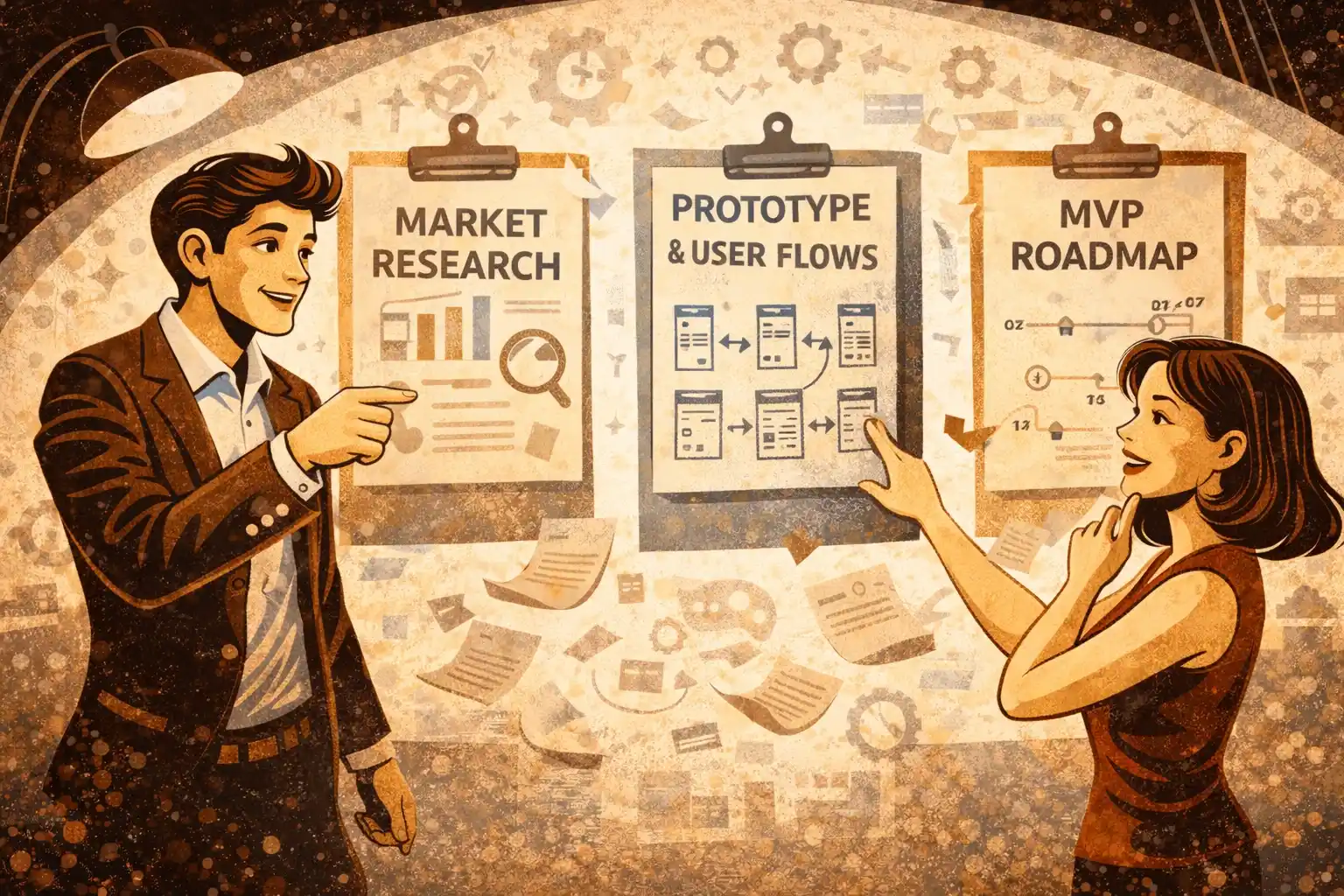
The choice becomes much easier once you stop asking, “What should I build?” and start asking, “What do I need to prove first?”
If you need to prove attention, interest, and message clarity, start with a website.
If you need to prove the product flow itself, build an MVP.
If you need to prove that people will actually pay for the outcome, start with a manual service.
That is the practical order many founders skip because they want to move directly to the most visible option.
But the cheapest path is usually not the path with the least work upfront. It is the path that avoids building something you did not need yet.
Why many founders build an MVP too early
An MVP sounds like maturity. It sounds like progress. It feels more “real” than a service or a landing page.
But many startups do not actually need a product first. They need proof first.
If the founder has not yet shown that the message resonates, that people care enough to engage, or that users will pay for the value, then software may simply turn uncertainty into expense.
This is especially common among non-technical founders who believe the product itself is the first signal of seriousness. Often, a sharper website or a better manual validation process creates more signal faster.
That is why Validate a Startup Idea Before Development: 5 Experiments That Work is so important in this context.
Why many founders overbuild the website too
The opposite mistake also happens.
Some founders keep polishing a website because it feels like safe progress. More sections. Better visuals. More copy. More pages. More SEO. But if the site is not attached to a real validation goal, it becomes a prettier delay.
A website should help the founder learn something useful. If it is not helping test message, collect leads, attract early demand, or support trust around a real offer, then it may be overbuilt too.
This is where clarity matters more than volume.
That connects well with Startup Website SEO in 2026.
A practical founder framework
Start by identifying the most important uncertainty in the startup right now.
If it is about how to explain the offer and attract early interest, build a website.
If it is about the product flow itself, build an MVP.
If it is about whether people will pay for the outcome at all, run the value manually first.
Then ask what is the smallest version of that asset that can answer the question honestly.
Most founders do not need more sophistication first. They need a better sequence.
Final thought
What to build first in 2026 is not a branding question or a technology question. It is a learning question.
Build the thing that removes the most important uncertainty with the least wasted effort.
Sometimes that is a website. Sometimes it is an MVP. And sometimes the smartest move is to sell the outcome manually before software enters the picture at all.
The founders who move best are usually not the ones who build the most first. They are the ones who build the right thing first.
Thinking about the smartest first move for your startup in 2026?
At Valtorian, we help founders choose the right path — website, MVP, or a leaner validation approach — and turn it into a practical launch plan with clear scope and real user focus.
Let’s look at your idea, your biggest uncertainty, and what you should build first to move faster without wasting budget.
FAQ
Should I build a website before an MVP?
Only if the main thing you need to validate is messaging, positioning, early interest, or credibility.
When should I build an MVP first?
When the key uncertainty is the product flow itself and users need to interact with the product to validate the idea.
What does a manual service prove?
It proves whether people value the outcome enough to engage or pay before software needs to exist.
Is a manual service too simple for a startup?
Not at all. For many early ideas, it is the fastest and smartest way to learn before automating anything.
What is the biggest mistake founders make here?
Building the most impressive thing first instead of the thing that removes the biggest uncertainty.
Can a website alone validate a startup idea?
Sometimes, but only when it is tied to a clear validation goal like waitlist signups, bookings, or lead capture.
How do I choose between the three options?
Ask what you need to prove first: message, product flow, or willingness to pay. That usually makes the answer much clearer.



























.webp)




.webp)