.webp)
Startup Website SEO in 2026
Startup website SEO in 2026 is not about chasing random hacks or adding technical layers just because a checklist says so. Founders need a website that is clear, useful, structured well, and able to support trust, traffic, and conversion at the same time. This article breaks down what actually matters for startup SEO now, which mistakes waste time, and how founders should think about SEO when the real goal is not rankings alone, but attracting the right people to a site that is ready for them.
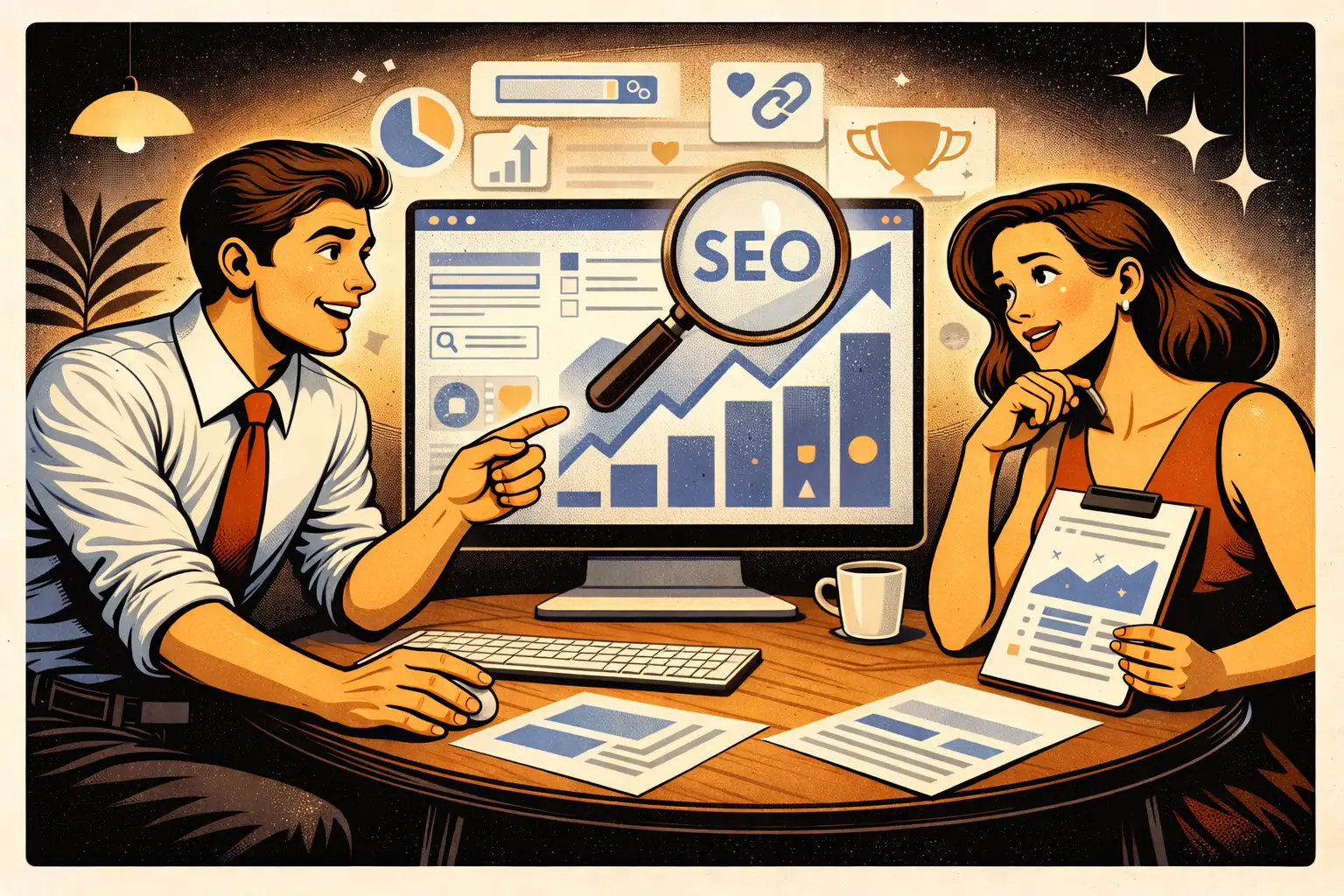
TL;DR: Startup website SEO in 2026 is still driven by basics done well: clear positioning, useful pages, strong structure, internal linking, page quality, and technical discipline where it actually matters. Most founders do not have an SEO problem first. They have a clarity problem, a structure problem, or a weak-site problem. Until those are fixed, extra optimization work rarely moves much.
Why founders keep overcomplicating SEO
Founders often treat SEO as a separate system from the website itself. They think rankings come from a set of add-ons: metadata, schema, plugins, tools, and keyword placement.
That is only part of the picture.
A startup website ranks better when it becomes easier for both users and search engines to understand. That means SEO is not just a traffic layer. It is a structure layer, a content layer, and a clarity layer.
When founders skip that and jump straight into technical tweaks, they usually end up polishing a weak base.
What actually matters most in 2026
The first thing that matters is positioning clarity. If the homepage, service pages, or solution pages do not clearly explain what the startup does, who it is for, and why it matters, SEO work gets weaker before it even starts.
The second thing is site structure. Search visibility improves when pages have clear roles. A homepage should not try to do everything. Service pages should have focused intent. Blog content should support discovery, education, and internal linking instead of floating separately from the business.
The third thing is page usefulness. Thin pages, vague copy, and generic startup language still fail in 2026. Search engines are better at noticing when a page says a lot without actually helping much.
The fourth thing is consistency. Founders often publish a few pages, a few posts, and then expect traffic growth without building a coherent system around them.
Why startup SEO is different from big-company SEO
A startup site does not have the same authority, content volume, backlinks, or brand familiarity as a larger company.
That changes the strategy.
A startup usually wins by being clearer, more focused, and more specific. It cannot outpublish bigger players on volume alone. It has to build relevance around specific problems, specific founder needs, and pages that actually deserve attention.
That is why broad, generic SEO strategies often fail for startups. They create effort without enough leverage.
A better approach is narrower. Fewer pages, stronger intent, better internal linking, clearer categories, and content that supports actual business goals.
The pages that usually matter first
For most startup websites, a few page types matter much more than the rest.
The homepage matters because it defines the main entity and first impression.
Core service or solution pages matter because they often carry the clearest commercial intent.
A focused blog matters when it supports discovery and internal linking, not when it becomes a disconnected content machine.
Case studies matter because they support trust, specificity, and conversion.
And category or comparison pages matter when they are genuinely useful and tied to how the target audience searches.
This is why SEO for startup sites is often less about “more pages” and more about “the right pages.”
What founders usually waste time on
The first waste is publishing articles that are too broad, too generic, or too disconnected from the company’s actual positioning.
The second waste is obsessing over technical details before the site has enough clarity or page depth to benefit from them.
The third waste is trying to rank everything from the start. Founders often spread effort across too many topics instead of building authority around a few high-fit themes.
The fourth waste is weak internal linking. Startups publish content but do not connect it into a clear system that supports service pages, related articles, and commercial intent.
The fifth waste is forgetting trust. SEO traffic means very little if the site does not feel credible once people arrive.
That is where Schema Markup for Startup Websites in 2026: What Actually Matters for SEO and Webflow Performance in 2026 fit naturally into the same conversation.
Technical SEO still matters, but in the right order
Technical SEO still matters in 2026, but it is not where most startup sites should begin.
If the pages are weak, technical cleanliness will not rescue them.
If the site is unclear, structured badly, or hard to trust, better schema or cleaner metadata will not solve the real problem.
The right order is simpler: first clarify the site, then strengthen the pages, then improve internal structure, then handle the technical layer properly.
This does not mean technical SEO is unimportant. It means it becomes much more valuable once the site is already worth understanding.
What a strong startup SEO system looks like
A strong startup SEO system usually has a clear homepage, strong service pages, a coherent blog strategy, disciplined internal linking, and content clusters that match real business intent.
It also has realistic expectations. SEO is not instant traction. It is a compounding channel that works better when the startup already knows what it wants to be found for.
That is why content and product positioning need to support each other. A startup cannot just “do SEO” in isolation. The site has to tell a believable story about who the company helps, what it builds, and why that matters.
This is especially relevant for non-technical founders, since the most common trap is building a site that sounds polished but still says too little.
That connects well with Web Development for Non-Technical Founders: A Step-by-Step Guide.
A practical founder framework
Start with the pages closest to business value.
Make sure your homepage, service pages, and key solution pages are clear enough to deserve traffic.
Then build a content system around what your audience is actually searching for, not around what sounds impressive in a content calendar.
Then strengthen internal linking so discovery pages support higher-intent pages.
Then clean up technical SEO where it genuinely helps.
Most startup sites do not need an advanced SEO machine first. They need a clearer site and a more disciplined growth structure.
That is why Tech Decisions for Founders in 2026 and From MVP to First Users in 2026 are useful follow-up reads.
Final thought
Startup website SEO in 2026 still works, but not through shortcuts.
It works when the website becomes clearer, more useful, more structured, and more aligned with how the right audience actually searches.
The founders who get value from SEO are usually not the ones chasing every tactic. They are the ones building a site that deserves visibility and then supporting it with the right SEO system.
Thinking about building a startup website or MVP that can actually support growth?
At Valtorian, we help founders shape clear websites and modern web or mobile products with real user focus, practical scope, and a stronger path to traction.
Let’s look at your site, your product stage, and what would actually improve clarity, trust, and long-term growth.
FAQ
What matters most for startup SEO in 2026?
Clarity, useful pages, strong site structure, internal linking, page quality, and technical discipline in the right order.
Should startups focus on technical SEO first?
Usually no. Most startup sites need better positioning, page structure, and content quality before deeper technical work matters much.
How many pages does a startup need for SEO?
Usually fewer than founders think. What matters more is having the right pages with clear purpose and strong intent.
Is blogging still worth it for startup SEO?
Yes, but only when the blog supports the business, the service pages, and a coherent topic strategy.
What is the biggest SEO mistake founders make?
Publishing too much generic content without a clear site structure or commercial connection.
Does website performance affect SEO?
Yes, but performance is only one layer. A fast weak page is still a weak page.
What should founders fix first?
Homepage clarity, service-page intent, site structure, internal linking, and overall trust signals are usually the best place to begin.













































.webp)




.webp)