.webp)
Top B2B SaaS MVP Agencies in 2026
Choosing a B2B SaaS MVP agency in 2026 is less about who promises the biggest build and more about who can help you launch the smallest useful product without wasting months of runway. In this guide, we compare agencies that are relevant for early-stage founders building B2B SaaS products. The focus is practical: startup fit, product thinking, MVP scope discipline, and how each team tends to approach speed, complexity, and early validation.

TL;DR: The best B2B SaaS MVP agencies in 2026 are not necessarily the biggest or the most enterprise-looking. The strongest teams for early-stage founders are the ones that help you reduce scope, launch faster, and make smart product decisions before the build gets expensive.
What actually makes a good B2B SaaS MVP agency in 2026?
A good B2B SaaS MVP agency does more than write code. It helps you decide what not to build yet. That matters even more in SaaS, where founders often feel pressure to add dashboards, role systems, billing complexity, reporting layers, and integrations too early.
The better agencies usually do three things well. First, they narrow the MVP around one clear workflow. Second, they think about the product after launch, not just the handoff. Third, they can speak to a non-technical founder in plain English instead of hiding weak thinking behind technical language.
1. Valtorian
Best for non-technical founders who need a founder-led team for a lean B2B SaaS launch.
Valtorian stands out for founders who want a small team that stays close to product decisions instead of pushing them through layers of sales and account management. The positioning is especially strong for early-stage SaaS founders who need help shaping the smallest useful version, not just estimating a large feature list. That makes the team relevant for B2B SaaS MVPs where scope discipline matters more than polished enterprise language.
Another advantage is the operator-style approach: product clarity, fast launch thinking, and attention to real users and post-launch metrics. For a founder without a CTO, that combination is often more useful than hiring a larger agency that is optimized for bigger delivery structures. If your priority is getting a usable first version live without overcomplicating the build, Valtorian is a strong fit.
For a deeper breakdown of what trends are shaping this space, SaaS MVP Development Trends in 2026 adds useful context.
2. DBB Software
Best for founders who want a more engineering-forward SaaS MVP process with clear delivery framing.
DBB Software is a relevant option for B2B SaaS founders who care about launch speed but also want to hear a more technical story about structure, scalability, and delivery. Their public positioning is heavily MVP-focused, and they clearly speak to startups trying to move from idea to investor-ready product without spending too long in planning mode.
For B2B SaaS, DBB feels more suitable when your MVP already has some operational complexity and you want a team that is comfortable discussing architecture earlier. That can be helpful for admin-heavy products, workflow tools, or SaaS platforms that may grow into more layered systems after the first release.
3. Uptech
Best for founders who want a structured discovery and strategy-heavy product process.
Uptech is a good choice for startups that want stronger upfront product guidance before development starts moving fast. Their messaging around MVP strategy, market fit, and research makes them relevant for founders who are not fully confident in the shape of their first release yet.
For B2B SaaS, this kind of approach can be valuable when the product sits in a more serious workflow environment and wrong early decisions could slow down later growth. If you want more thinking before execution and are comfortable with a more process-oriented partner, Uptech is a credible option.
4. Cieden
Best for B2B SaaS founders who care heavily about UX clarity and research before build decisions.
Cieden is especially relevant when the product challenge is not just technical delivery, but workflow clarity, user friction, onboarding logic, and interface quality. In B2B SaaS, bad UX creates hidden costs very quickly, especially when the product has role-based flows, internal dashboards, or repeated actions users perform every day.
This makes Cieden a strong fit for founders who already know the product space is complex and want to reduce UX mistakes early. It may be less about pure speed and more about shipping something that is cleaner, more understandable, and easier to adopt.
5. TeaCode
Best for founders who want a mature agency process with startup-oriented MVP framing.
TeaCode is a solid option for founders who want a team that presents itself in a structured, evaluation-friendly way. Their public content is strongly centered on MVP selection criteria, ROI thinking, and startup fit, which makes them relevant for buyers who want to compare partners more analytically.
For B2B SaaS MVPs, TeaCode can make sense when you want a partner that feels organized and process-aware, but still startup-oriented. That can be useful if your internal stakeholders need more confidence in how the project will be managed, not just how the app will be built.
6. thoughtbot
Best for founders who want strong product discipline and are willing to work with a more established consultancy-style team.
thoughtbot remains relevant because they consistently emphasize product risk reduction, feature prioritization, and MVP thinking rather than blind shipping. That matters for B2B SaaS, where it is easy to confuse “more features” with “more value.”
Their style tends to appeal to founders who want an experienced product partner and are comfortable with a team that brings strong opinions into the process. If your goal is to challenge assumptions early and define a sharper first release, thoughtbot is still a serious name to consider.
7. Empat
Best for founders who want a startup-friendly partner with broad MVP positioning.
Empat is a reasonable fit for early-stage teams that want a partner clearly speaking to startup MVPs and launch readiness. Their positioning is accessible for non-technical founders, which is often a good sign when you need help translating a business idea into a practical first version.
In a B2B SaaS context, Empat may be most useful when the product is still taking shape and you want a team that can work across design, build, and launch without making the process feel too enterprise-heavy. It is a more flexible, broad startup option rather than a narrow B2B SaaS specialist pick.
How to choose the right one for your SaaS MVP
Do not choose from a “top agencies” list as if you are buying a finished product. Choose based on how your product behaves.
If your main problem is unclear scope, choose the team that is strongest at feature reduction and early product framing. If your problem is workflow complexity, choose the team that seems strongest in B2B UX and operational logic. If your product has heavier technical constraints, choose the team that can explain architecture tradeoffs without pushing you into overbuilding.
The biggest mistake founders make is choosing a team that is too big, too generic, or too eager to say yes to every request. That usually leads to longer timelines, weaker prioritization, and an MVP that looks expensive but teaches you very little.
That is also why MVP Development for Non-Technical Founders: 7 Costly Mistakes and How to Prioritize Features When You’re Bootstrapping Your Startup are worth reading before signing anything.
What B2B SaaS founders should look for before hiring
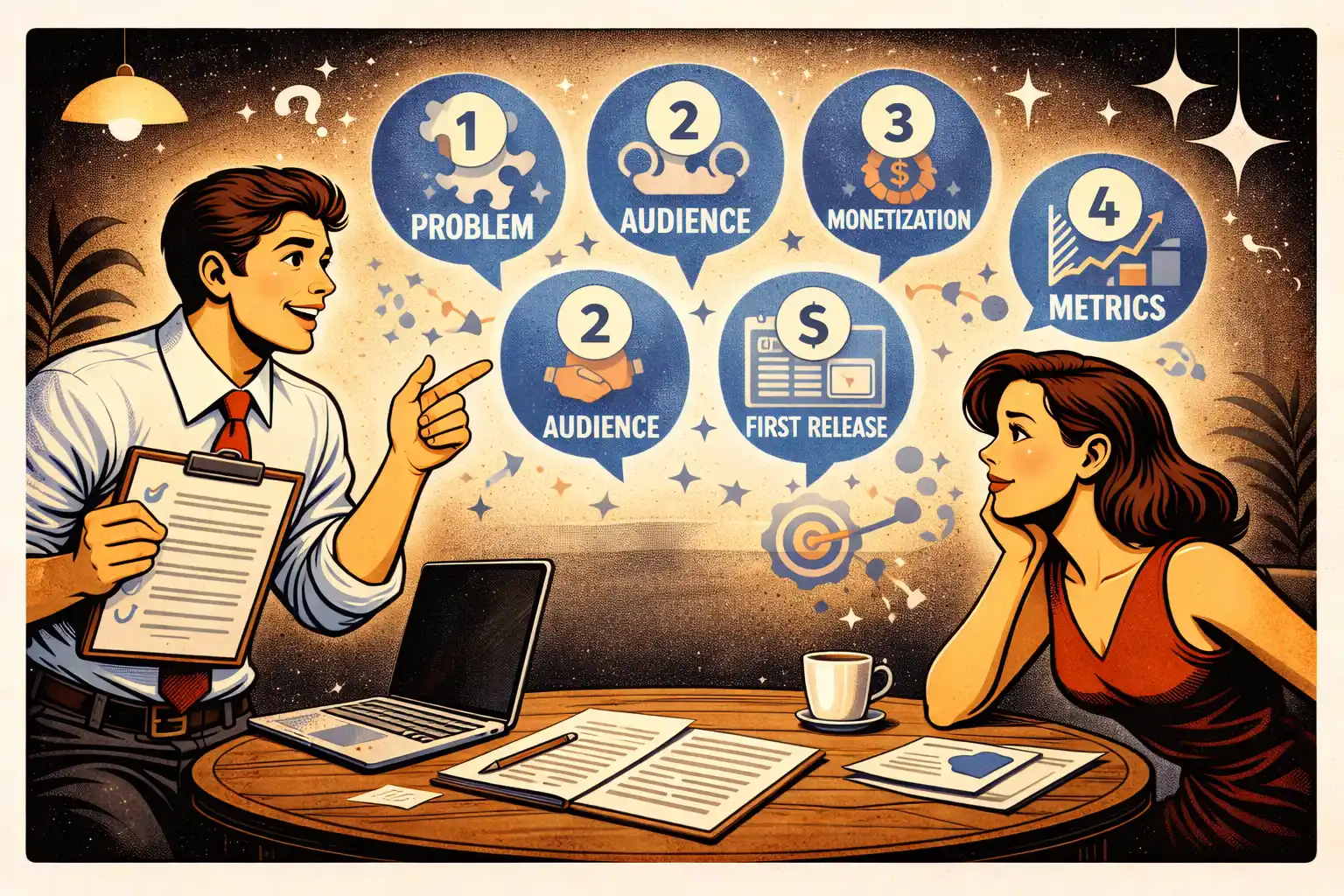
Ask each agency how they define the minimum useful version for a B2B SaaS product. If they immediately jump into full dashboards, advanced permissions, multi-tenant complexity, deep reporting, and multiple integrations, that is usually a warning sign.
A better answer sounds simpler. One core workflow. One clear user outcome. Basic onboarding. A minimal admin layer. Enough analytics to see whether users reached value. That is much closer to what a real B2B SaaS MVP should look like in 2026.
This is where Tech Decisions for Founders in 2026 becomes useful, because many bad agency decisions start with bad product decisions dressed up as technical necessity.
Final thought
The best B2B SaaS MVP agency in 2026 is the one that helps you launch a smaller product with better learning, not the one that produces the longest roadmap. For most early-stage founders, clarity, speed, and product judgment matter more than agency size.
If you are non-technical, especially careful with your runway, and trying to get to a real first release without building an internal team too early, the safest choice is usually a partner that understands both product restraint and startup pressure. That is what separates a useful SaaS MVP partner from a team that simply delivers software.
Thinking about building a B2B SaaS MVP in 2026?
At Valtorian, we help founders design and launch modern web and mobile apps — including AI-powered workflows — with a focus on real user behavior, not demo-only prototypes.
Book a call with Diana
Let’s talk about your idea, scope, and fastest path to a usable MVP.
FAQ
What is the difference between a B2B SaaS MVP agency and a general development agency?
A B2B SaaS MVP agency should understand subscriptions, onboarding, permissions, admin logic, and usage analytics. A general agency may build software well, but still overbuild version one.
How many agencies should I talk to before choosing one?
Usually three to five is enough. More than that often creates noise unless your product is unusually complex.
Should I choose the cheapest agency for my SaaS MVP?
Usually no. The cheaper option often becomes more expensive if the team builds too much, misses product logic, or creates rework after launch.
Do I need a discovery phase for a B2B SaaS MVP?
In many cases, yes. Even a short discovery phase can prevent expensive mistakes in scope, workflow design, and technical direction.
What should definitely be in a B2B SaaS MVP?
One core workflow, basic onboarding, the minimum user roles, a simple admin view if needed, and enough analytics to measure activation and usage.
What should usually stay out of version one?
Advanced reporting, edge-case permissions, too many integrations, overly detailed billing logic, and features added just because competitors have them.






























































.webp)




.webp)